


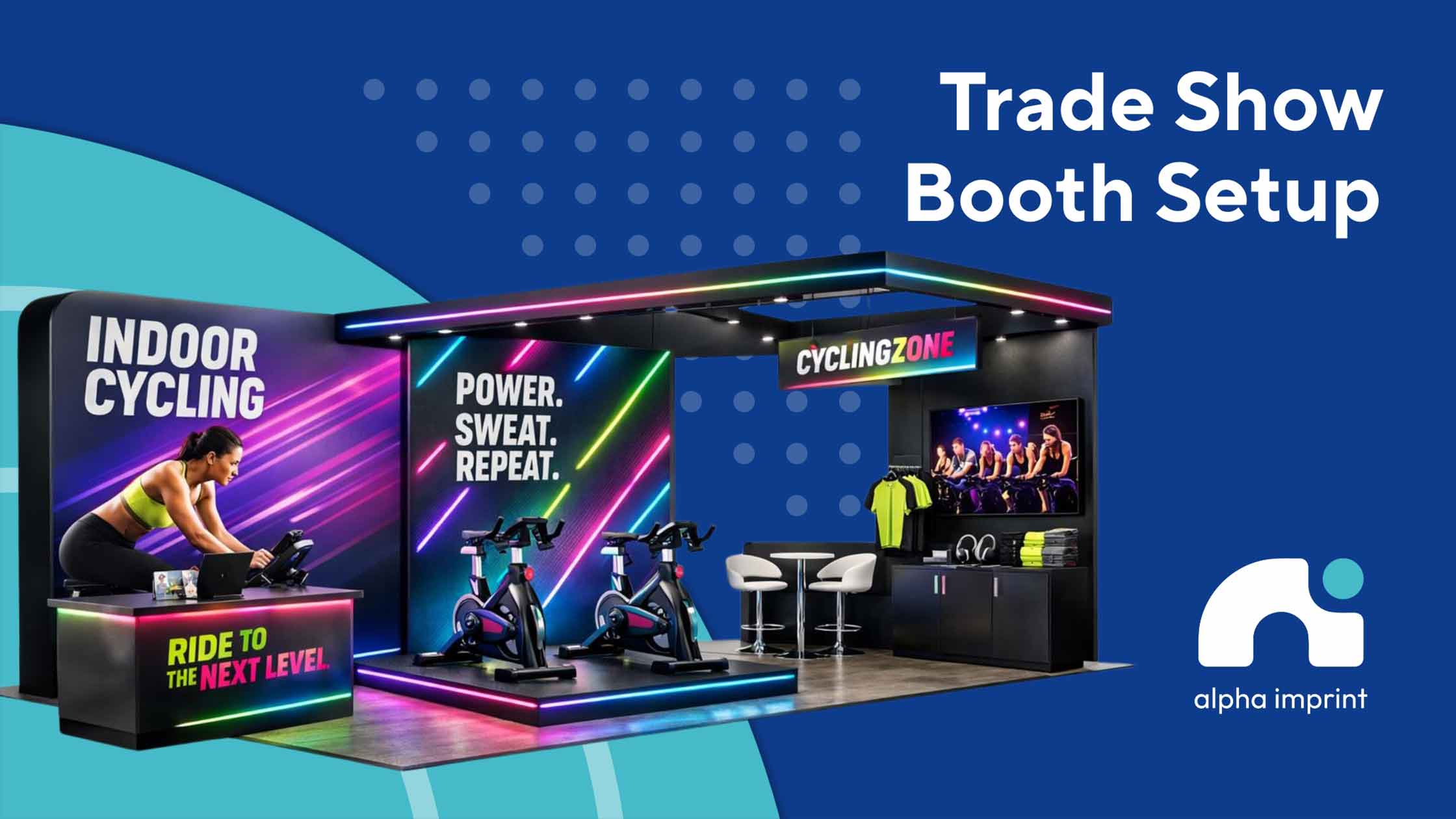
How to set up a trade show booth? To get real results from an exhibition, think of your trade show booth setup as a system instead of just temporary decoration.
Setting up a booth isn’t just about putting together a few elements; a successful trade show booth setup is a combination of design, strategy, and execution. If not done right, the high cost will be unrecoverable.
In this step-by-step guide, you’ll learn how to create a booth that gets noticed.
Steps for Setting Up a Trade Show Booth (Quick Answer!)
- Define your goal (leads, branding, demos)
- Pick layout + plan flow (entry, movement, visibility)
- Prepare budget, logistics, and materials (label + test everything)
- Design clear visuals + add interaction (simple message, engaging element)
- Install in order + test onsite (structure → graphics → tech → check all)
- Train staff, engage visitors, follow up fast
Pre-Show Planning: The Foundation of a Successful Booth Setup
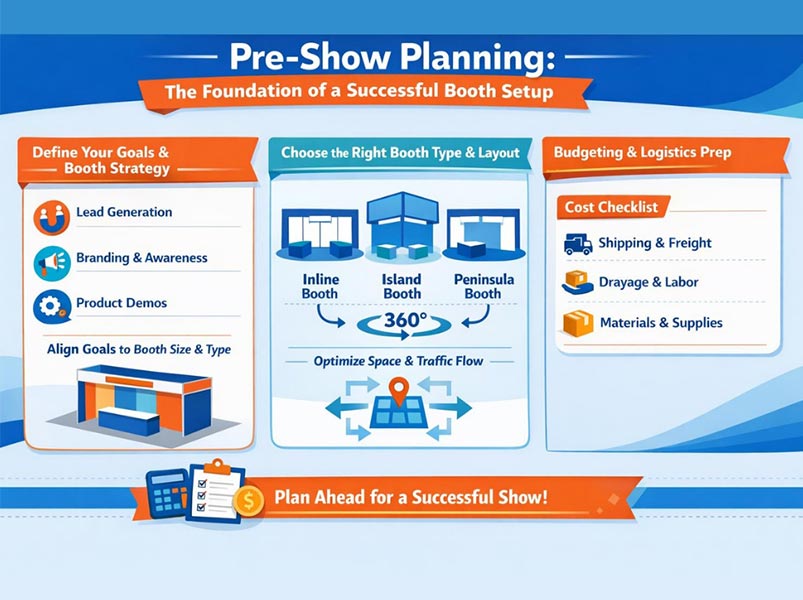
Define Your Goals and Booth Strategy
First, you need to know exactly what you want from this show. If your goal is to get leads, the layout should be inviting and easy to understand. If you are focusing on branding, visibility and visual identity become even more important.
For demos, you also need to see the space, the movement path, and where the audience will stop.
In short, booth setup planning starts with the goal; otherwise, you end up with a booth that may be beautiful but does not clearly show what it will do.
Choose the Right Booth Type and Layout
Not all booths are right for all brands. A good trade show booth layout should reflect your budget, goals, and target audience. An inline is simpler and more compact; an island offers greater visibility; and a peninsula usually works better for movement and demos.
In expo booth set up, don’t just think about what goes where; think about where people will enter, where they will stand, and what will grab their attention first.
Budgeting and Logistics Preparation
The cost of a booth isn’t just what you see at first glance. Often, the real cost comes from shipping, drayage, labor, electricity, printing, and the little details of setup day. That’s why you need to look at booth installation cost realistically, not optimistically.
In trade show installations, a checklist can help identify what needs to be shipped early, what needs to be done onsite, and where hidden costs might arise. This preparation can take away half of the day’s stress.
Booth Design That Attracts and Engages Visitors
Visual Design and Branding Essentials
A good design should make an impression right away.
Colors should match your booth branding, text should be short, and display graphics should be large enough to be read from the aisle.
If you have limited space, use large graphics and a clear message instead of filling the booth with too much stuff.
At busy trade shows, even for trade show booths in Houston, it’s that initial clarity that determines whether someone pauses.
Creative Ideas to Stand Out
It’s not enough to just have a pretty backdrop to stand out. The trade show booth ideas that really work usually include an interactive element, such as a live demo, a mini-game, a touchscreen, or a VR experience.
Light, movement, and a tactile experience help the booth go from spectator to participant. This is exactly where the best interactive booth ideas work: when they make people stay a few seconds longer and engage with the brand.
Signage and Messaging Optimization
The booth message should be layered and immediately understood: first, the headline; then a short description; then the CTA. This is one of the best signage ideas that many still ignore.
The font should be legible from a distance, the CTA should be prominently placed, and the main elements should be positioned directly in the eye’s path.
In competitive markets like signage in Houston, the same principle applies: less message, but clearer and faster.
Step-by-Step Trade Show Booth Setup Process
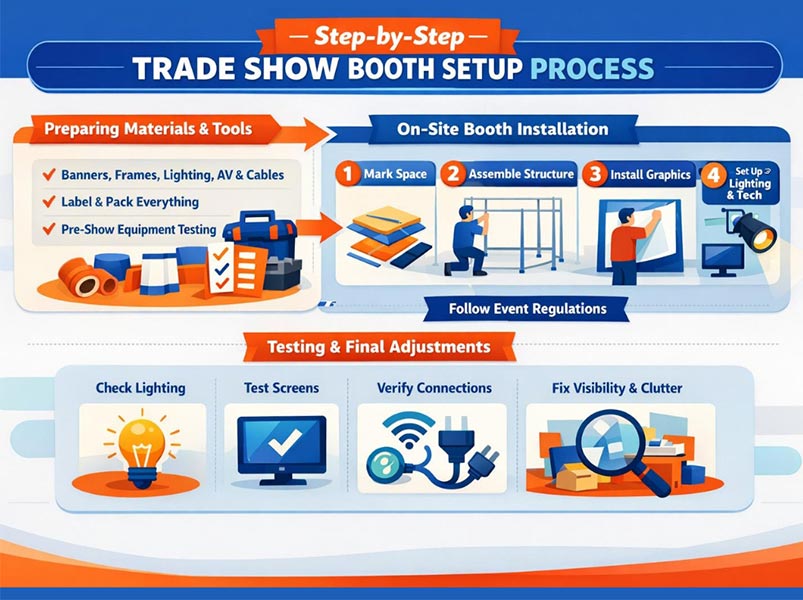
Preparing Materials and Tools
You should have most of the work finished before you even get to the show.
A good booth setup starts with careful preparation: banners, frames, lighting, cables, AV, mounting hardware, extensions, tape, and everything else that is part of the booth equipment should be labelled and organized for packaging.
If the pieces are similar, numbering them can be a blessing. It’s a good idea to test the screen, lights, cables, and any electrical equipment before you travel so you don’t waste time on the day of the show looking for obvious faults.
Be prepared not just with the booth materials, if you’re planning to offer trade show giveaways, you must order them 6 to 8 weeks before the trade show begins
On-Site Booth Installation
When you arrive at the venue, don’t go straight to the graphics. First, check the booth boundaries with the floor plan and make sure you’re exactly inside the reserved space.
Then, close the main structure, secure the floor or backdrop, and only then install the graphics. Next, set up the lights, screen, power, and tech.
This is very important in trade show booth setup, because if you go the other way, you will burn and damage the parts more.
In trade show installations, you also need to pay attention to venue rules, height restrictions, electrical requirements, safety, and setup timing.
Testing and Final Adjustments
After installation, don’t think you’re done.
This is where the booth setup checklist really comes in handy:
- Are the lights working properly?
- Are the screens working?
- Are the internet and connectivity stable?
- Is the CTA legible from the aisle?
Now walk past the booth like a visitor and look at it from different angles.
If something is cluttered, the message is missing, or the entry path is not natural, fix it right there. A good exhibition booth set up is not only about putting the parts together; it should also look perfect to the audience.
Staffing and Engagement Strategies During the Event
Training Your Booth Team
Having an impressive booth is only one facet of the equation; success also hinges on a well-prepared, adept team. “Is your team as ready to engage as your booth is to attract?”
For trade show staff training, first clarify roles: one person to greet and initiate conversation, one to demo and explain the product, and one to collect leads or move the next step forward.
This clarity of booth team roles prevents confusion during a busy day.
In addition, the team should know both the brand message and how to speak concisely, naturally, and professionally.
Practicing real-life scenarios and role-plays also goes a long way to ensuring that the conversation on the floor doesn’t feel artificial or dry.
Attracting and Converting Visitors
Attracting people isn’t just about standing there and smiling.
For booth engagement, you need a hook: a short question, a quick demo, a clever giveaway, or an interactive experience that keeps people engaged.
After that, you need to quickly identify whether you are dealing with a curious visitor or a real lead.
This part of the lead-generation trade show is very important because the quality of the conversation matters more than the number of business cards. A proactive team that knows how to ask the right questions usually generates better leads.
Common Trade Show Booth Setup Mistakes to Avoid
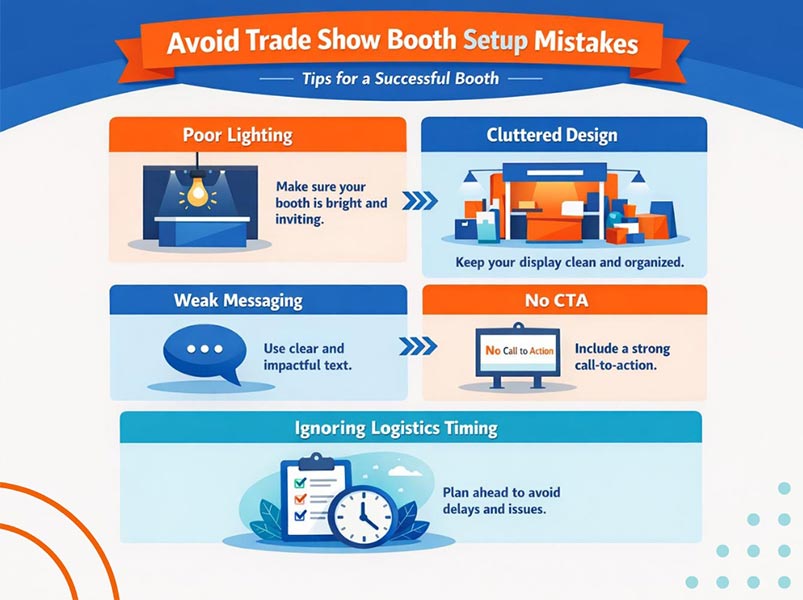
Among the most common trade show booth mistakes, poor lighting makes the booth look lifeless and unattractive; the solution is to focus lighting on the product and headline.
A cluttered design is also one of the worst booth setup errors, as it both loses the message and makes it harder to enter; the cure is to eliminate clutter and keep the flow open.
A weak or ambiguous message makes it difficult for visitors to understand exactly what you are offering, so keep the headline short and to the point.
No CTA means wasted attention; leave a clear “Call,” “Scan,” or “Book Demo.”
The final mistake is neglecting logistics scheduling; delays in shipping, setting up, or testing equipment can easily ruin the day of the show.
The solution is a checklist, labelled packaging, and pre-show testing.
Post-Show Breakdown and Follow-Up
Efficient Booth Dismantling
Boot teardown doesn’t have to be sloppy or rushed. It’s best to unpack your setup in reverse order: tech and sensitive items first, then graphics, then structure. In a booth teardown, labelling boxes and returning each piece to its designated spot prevents loss and damage.
In trade show dismantling, venues are often sensitive to both timing and orderly unpacking, so booth packing needs to be both fast and calculated.
Lead Follow-Up and ROI Tracking
The reality is that the most important part of trade show ROI starts after the show is over.
If you do lead follow-up within the first 24 to 48 hours, your conversion rate is much higher, especially when you segment your message by lead quality and conversation type.
In a good post-event strategy, you need to see if the end result was consistent with your initial goal: how many leads came in, how many were qualified, and which part of the booth actually performed best.
Conclusion
A successful trade show booth setup is not put together at the last minute.
It requires planning, teamwork, and some creativity. When you plan well and follow through, your booth looks appealing, helps you connect with more people, and helps you achieve better results at your next event. And now, you know how to set up a trade show booth.