


The key to trade show booth design is not what to add; it’s what to remove to make the message clearer.
Today’s trade show booth design tips aren’t just about how your booth looks; it’s about creating a fast, clear, and memorable experience. In the first few seconds, a visitor decides whether to stop or pass. As such, booth design directly impacts first impressions, engagement quality, and ROI.
This guide focuses on strategy, design, and conversion.
Quick Tips For Design of Trade Show Booth (Quick Answer!)
| Area | Key Tip | What It Means |
|---|---|---|
| Strategy | Start with clear goals & audience | Design based on purpose (leads, awareness, launch), not decoration |
| Funnel Alignment | Match booth to buyer journey | Awareness (grab attention) → Consideration (demo) → Conversion (CTA) |
| Layout | Choose the right booth type | Inline, corner, peninsula, island—based on budget & visibility needs |
| Space Planning | Optimize flow | Clear entrance, visible focal point, defined zones, no clutter |
| Visual Design | Use bold, simple graphics | Large, readable visuals with consistent branding |
| Messaging | Keep it clear & structured | Headline + support + CTA; readable from a distance |
| Engagement | Add interactive elements | Touchscreens, demos, games increase dwell time |
| Technology | Use tech with purpose | Screens/VR should explain or convert—not distract |
| Small Booths | Prioritize simplicity | One message, use vertical space, modular design |
| Conversion | Guide visitor actions | Clear path: attract → engage → act (CTA visible) |
| Staff Role | Train booth team | Staff should align with design and drive conversations |
| Creativity | Add memorable elements | Unique themes or experiences that reflect the brand |
| Budget | Spend on visible impact | Prioritize graphics, lighting, and experience over structure |
| Measurement | Track ROI | Evaluate engagement, dwell time, conversions—not just leads |
| Finishing | Use lighting & quality materials | Highlight key areas and ensure premium look/feel |
1. Start With a Clear Booth Design Strategy
Define Your Goals and Target Audience
First, you need to know what your booth will do for you. If your goal is lead generation, the design should be easy to understand, inviting, and conversational.
If you’re focused on brand awareness or a product launch, visibility, the main message, and the focal point become even more important.
This is where event booth design and convention booth design move beyond decoration and into real decision-making. In a good trade show strategy, you first know your audience: what their industry is, what they’re looking for, and what they usually stop for.
Then you design your booth based on that. In fact, design of booth works best when it starts with the purpose, not the decor.
Align Booth Design with Marketing Funnel
A good booth isn’t just about being seen; it should take people one step further. In the awareness stage, the design should grab attention with a strong graphic, a clear headline, and a good reason to stop.
In the consideration stage, the demo, screen, sample, or quick explanation comes in. In the conversion stage, the CTA, form, badge scan, or meeting invitation becomes important.
This is exactly where trade show booth design tips leave the taste mode and enter conversion design. That is, each section of the booth should know which stage of the funnel it is working in.
Quick Tip: Did you know you could also drive attention and create long lasting impressions using custom trade show giveaways?
2. Choose the Right Booth Layout for Maximum Impact
Understand Different Booth Types
The type of booth has a huge impact on visibility, cost, and freedom of action. In exhibition booth design, inline booths are usually more economical but are only open on one side and offer limited visibility. Corner is visible from two aisles and is a smart upgrade for many brands.
Peninsula is open on three sides and works better for demos and flow.
The island is also visible from all sides, giving more freedom for trade show booth designs that aim to be more experiential, but at a higher cost and with greater complexity.
The right choice here is more about budget and purpose than aesthetics.
Optimize Traffic Flow and Space Usage
A good layout should facilitate movement, not hinder it. In successful booth layouts, the entrance is clear, the focal point is easily seen, and the space is divided between demo, display, and meeting areas.
For open booths, flow is usually more natural, but closed layouts, if executed correctly, can create a more controlled feel. In small booth designs, especially 10×10, this becomes even more important because every square foot of space has to do two things.
Using height, simple zoning, and avoiding cluttered layouts usually yield much better results.
3. Create a Visually Compelling Trade Show Booth Design
Use High-Impact Graphics and Branding
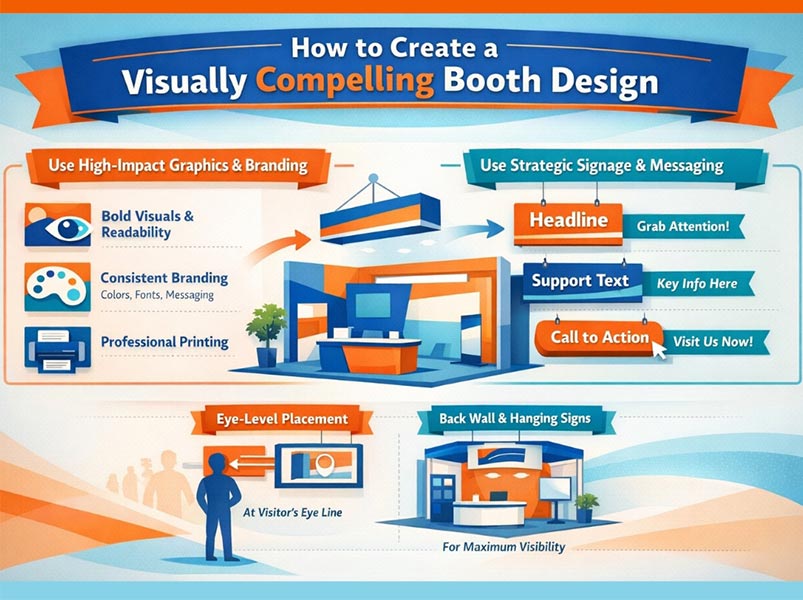
The look of your booth should make the task clear at first glance. In exhibition booth design, graphics should be large, clear, and legible from a distance; not detailed and boring.
When the color, font, image, and tone of the message are consistent throughout, branding consistency is created and the brand sticks in the mind much faster. The print quality is no joke here; a poor graphic or dull colors can easily detract from the booth’s overall professional feel.
In practice, a booth that is not busy but bold and bright is more likely to be seen.
Use Strategic Signage and Messaging
In crowded markets, even for signage in Houston, the priority is to ensure the message is immediately understood. The best structure is usually: a short headline, a supporting explanation, and then a CTA.
If the text can’t be read from a distance, it doesn’t really exist.
So, the back wall should convey the main message, eye-level elements should provide quick information, and hanging signs should improve visibility from a distance.
The clearer the hierarchy, the less confused the audience will be, and the faster they will be able to engage in the conversation.
4. Incorporate Engagement-Driven Design Elements
Add Interactive Features to Attract Visitors
People often don’t stop by the booth because of its shape; they stop by because of what they can do inside. A good interactive booth can feature a touchscreen, a mini game, a live demo, or even simple VR.
The reason is clear: interaction increases dwell time, and the longer the dwell time, the greater the chance of conversation and lead generation.
Among engagement strategies, those that are both easy to understand and turn the audience from spectators into participants work best.
Use Technology to Enhance Experience
In event booth design, LED walls, interactive screens, and digital displays are effective when they serve a clear purpose: to explain a product better, provide a demo, or help capture leads. If the booth is small, a good touchscreen usually works better than a few scattered devices.
If the booth is larger, AR or VR can deepen the experience, but only if the lighting, sound, space, and ready-to-use team have been envisioned in advance.
5. Maximize Small Booth Spaces (10×10 Strategy)
Use Vertical Space and Modular Design
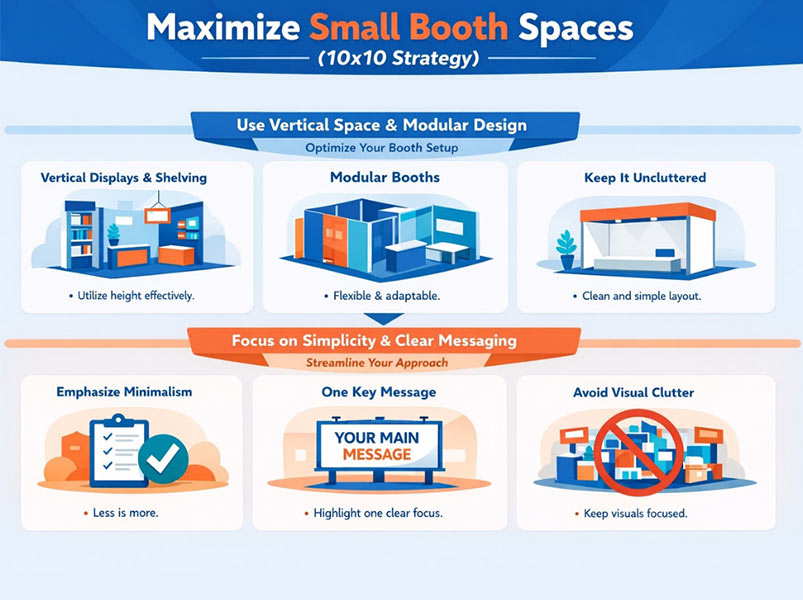
In a 10×10 booth design, the floor space runs out quickly, so you need to use height. Vertical shelving, tall graphics, hanging elements, and narrow stands help the booth feel both open and visible.
Being modular is also a serious advantage here; you can move pieces around for different events and adapt the layout to the space without clutter. In many small booth layouts, just using height correctly keeps the booth from looking smaller than it is.
Also Read: 10×10 craft booth layout ideas
Focus on Simplicity and Clear Messaging
In a small booth design, the biggest mistake is trying to show everything at once. A small booth should have one main message, not five half-messages. A short headline, a limited but strong graphic, and a clear CTA usually work much better than a wall of text.
Of all the trade show booth design tips, this is perhaps the most important: Being quiet doesn’t mean being weak; it means that the audience understands what to pay attention to more quickly.
6. Design for Conversion, Not Just Attention
Guide Visitors Toward Action
Many booths grab attention, but they don’t lead anyone to the next step.
The difference is that the layout should guide the visitor: first, stop; then, interact; then, take action.
The CTA should be somewhere it’s actually seen; on a sign, screen, counter, or even on staff prompts. If your goal is a signup, demo, or consultation, this path should be clear.
Lead capture works best when it’s embedded in the flow of the booth, not something you just remembered at the end.
Train Staff to Complement Booth Design
The booth team is part of the experience design, not separate from it. If the staff doesn’t know when to approach, what to say, and how to lead the conversation, even the best design will be incomplete.
Approachable behavior, short questions, and natural scripts help keep event engagement organized.
When the team’s behavior is aligned with the booth’s purpose, trade show success isn’t just about the booth’s appearance; it’s also about the quality of the interactions. Design paves the way, but it’s the people who make it happen.
7. Use Creative Booth Design Ideas to Stand Out
Add Unique and Memorable Elements
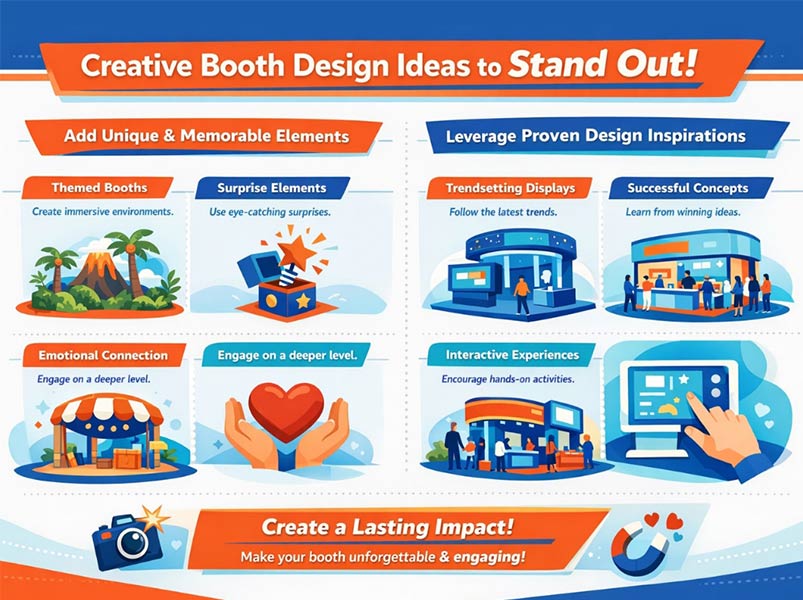
What makes people stop by a booth isn’t always just the color and graphics; sometimes it’s a different feel. A distinct theme, a narrative in the space, or an unexpected element can turn a booth from “just another booth.”
Among creative booth ideas, the best are those that aren’t just quirky but also bring the brand to life. In today’s successful exhibition booth designs, those memorable details are often the ones that create a small emotional response and make people remember the booth later.
Leverage Proven Design Inspirations
Not all good ideas have to be invented from scratch. Many successful trade show booth ideas come from tried-and-true patterns: immersive spaces, minimal yet powerful layouts, and experiences that engage multiple senses at once.
At busy events like trade show booths in Houston, inspiration is worth it when you align the concept with your brand personality, rather than just repeating it exactly. A good idea is one that both stands out and actually works for your audience.
8. Plan Logistics, Budget, and ROI
Manage Cost with Design Impact
“How should a trade show budget be allocated for maximum impact?”
Budget should not be lavished merely on the physical framework. In many well-conceived projects, visuals, illumination, and technology transcend the bare skeleton of the booth and become the true carriers of its presence. Thus, a thoughtfully crafted trade show budget must harmonize structure, narrative, and experiential depth.
A more expensive booth isn’t always better; what matters is how the booth’s cost is spent. In professional exhibition planning, spending on what visitors actually see usually yields better results.
Measure Success and Optimize
If the design is going to be better, it needs to be measured after the show. Trade show ROI isn’t just measured by lead count; engagement, dwell time, conversion, and conversation quality are also important.
Post-event performance tracking helps you understand which parts of your booth worked, which didn’t, and what needs to change for the next round.
9. Final Touches: Lighting, Materials, and Finishing Details
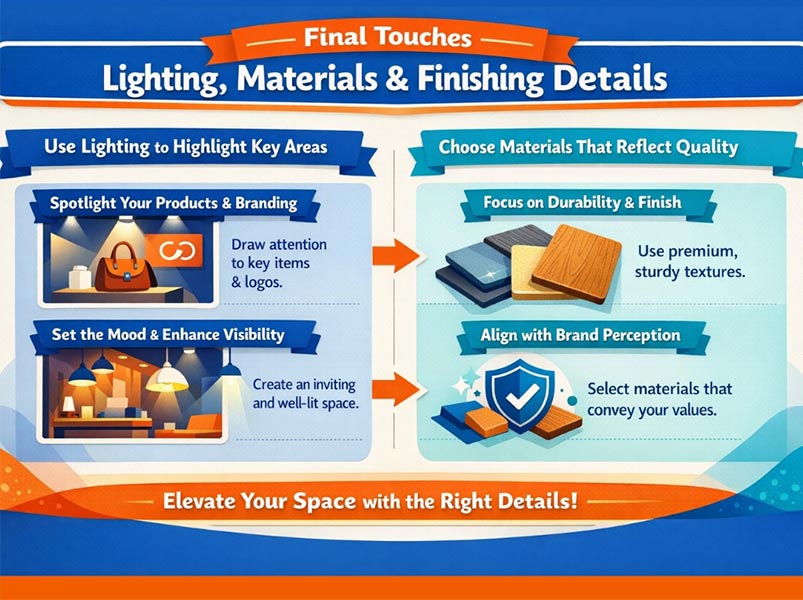
Use Lighting
When used properly, booth lighting can highlight the main product, logo, headline, or demo area, improving your booth’s visual impact.
Spotlighting on the product, soft lighting for the space, and backlighting for graphics are often more effective than uniform, unfocused lighting.
Choose Materials That Show Quality
Materials are what make your brand stand out before you speak. The finish, texture, durability, and clean execution directly impact the feel of a premium display. If the material looks cheap or flimsy, the entire booth will look weaker.
Among the best signage ideas, it’s often the one that works best: it doesn’t just have great graphics but also a feeling of quality in the materials and finish.
FAQs
What makes a good trade show booth design?
A good booth design has a clear message, an easy entry, readable graphics, a clear call to action, and enough space for visitors.
How do I design a small booth effectively?
For a small booth, make use of height, keep things simple, focus on one main message, and set up the space so people can quickly understand what you offer.
What are the best booth layouts?
The best layout depends on your goal, but usually, an open entrance, a natural flow, and clear areas for different activities work well.