


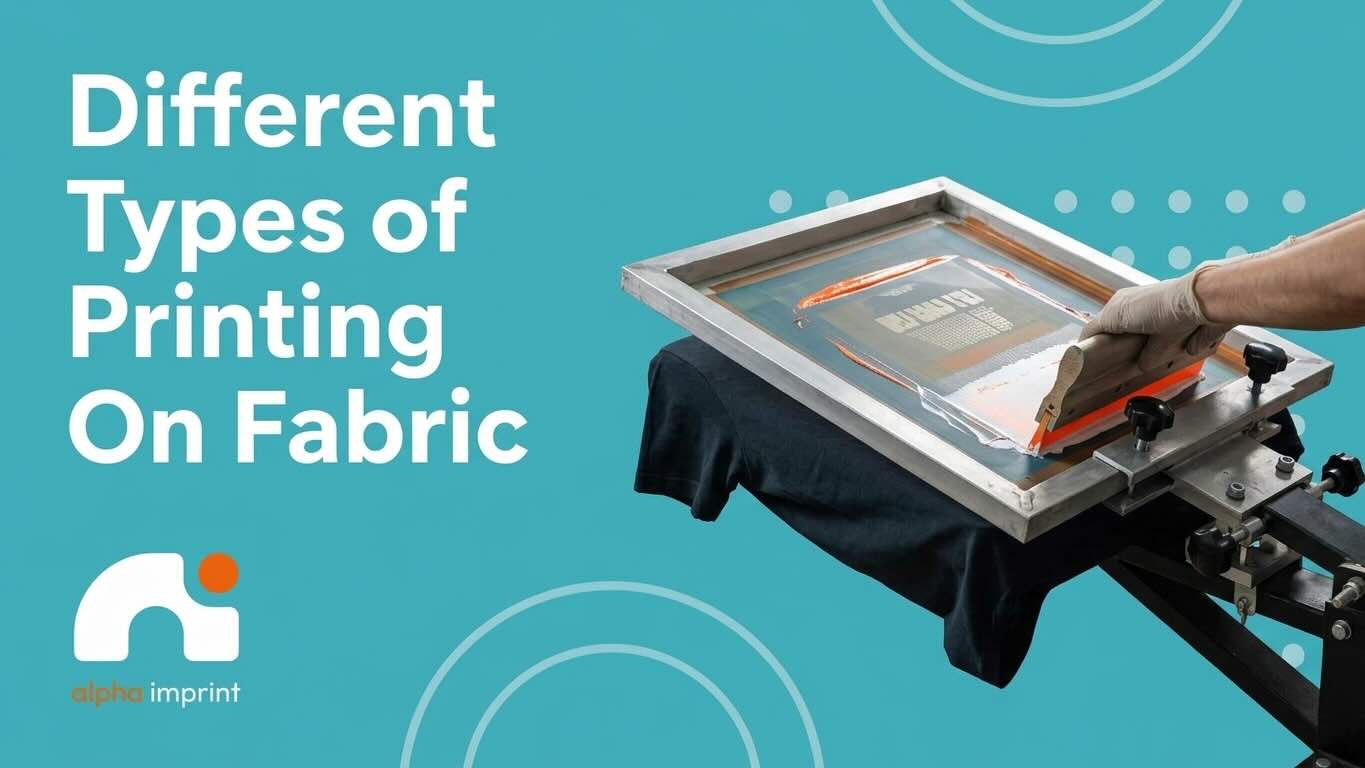
Not every fabric should be printed the same way. A polyester sports jersey, a cotton T-shirt and a silk scarf all respond differently to ink, dye, heat, and pressure. That is why understanding the different types of printing on fabric matters.
The right choice depends on the material, artwork, quantity, durability, feel and budget.
Quick Answer
| Method | Works Best On | Best For | Main Trade-off |
|---|---|---|---|
| Stamp / Block Printing | Most woven textiles | Handmade goods, craft projects, short artistic runs | Imperfections are part of the look — not for exact repeatability |
| Heat Transfer | Broad range, but transfer must match the garment | Personalized apparel, colorful logos, small quantities | Covers several technologies; feel and wash performance vary |
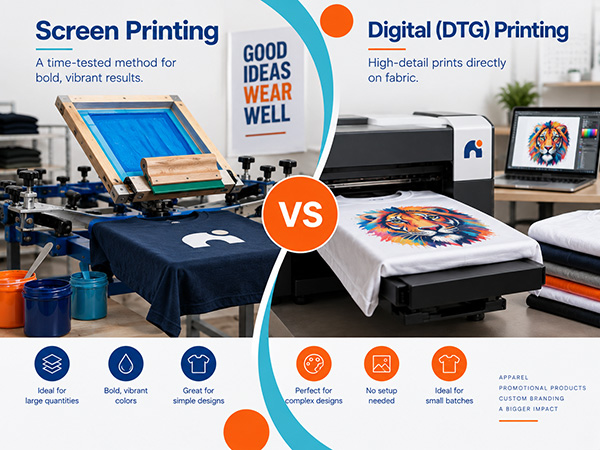
| Screen Printing | Cotton, blends, bags, workwear | Bold solid colors and clean graphics at higher volumes | Each color needs its own screen — setup is costly on small runs |
| Dye-Sublimation | Polyester and compatible synthetics, white/light bases | Photos, gradients, sportswear and performance wear | Not suited to ordinary cotton or dark bases |
| Pigment Printing | Natural fibers, synthetics and blends | Detailed artwork without screens, on varied fabrics | Binder quality drives softness, rub and wash resistance |
| Reactive / Acid Dye | Reactive: cotton, linen, rayon, hemp · Acid: wool, silk, nylon | Vibrant color with strong wash performance | Multi-stage process — pretreatment, fixation, steaming, washing |
| Direct-to-Garment (DTG) | Finished garments, fabric composition dependent | Photographs, gradients, many colors, small runs | Result depends on pretreatment, curing and garment quality |
Alpha Imprint; Trusted Local Partner for Screen Printing in Houston
At Alpha Imprint, we work with Houston businesses that need printed apparel for teams, events, uniforms, giveaways, and everyday branded wear.
T-shirts and hoodies are obvious choices, but screen printing also works well on bags, workwear, and many other fabric products.
Why do we recommend it so often for bold company artwork?
Because professional screen printing can reproduce solid colors and clean graphics consistently across a full order. Once the screens are prepared, the same design can be repeated efficiently from piece to piece.
If you need to screen print in Houston, we can also help you decide whether traditional screen printing actually suits the job or whether DTG, heat transfer, or another option makes more sense for your artwork and quantity.
We also offer specialty and multi-color screen-printing options for projects that need something beyond a basic logo.
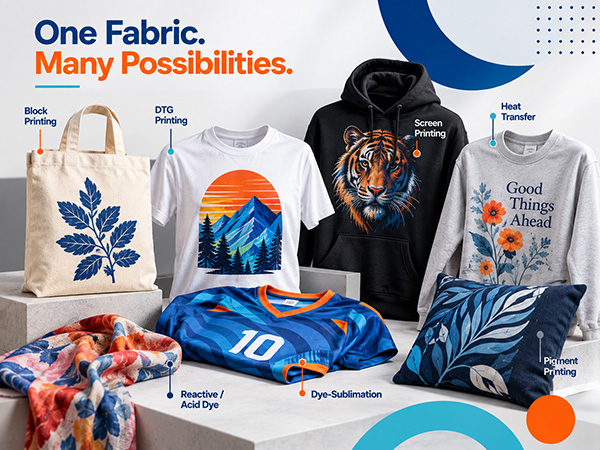
What Are the Different Types of Printing on Fabric?
So, what actually changes from one method to another?
Some types of fabric printing leave ink mainly on the textile surface. Others use heat or chemical reactions to move color into, or bond it with, the fibers themselves.
That difference affects almost everything: how the print feels, which fabrics it works on, how much detail it can hold, and whether it makes sense for five pieces or five thousand.
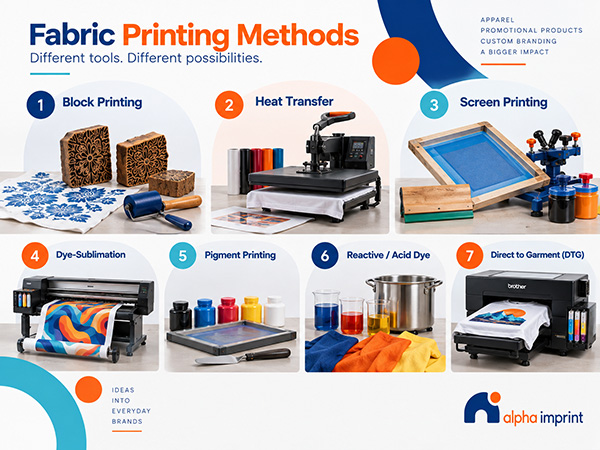
7 Professional Fabric Printing Techniques and How They Work
Stamp and Block Printing
Block printing is one of the easiest methods to understand. A carved block is coated with ink or dye and pressed onto fabric, then the process is repeated to build the pattern.
Its imperfections are often part of the appeal. For handmade textiles, craft projects or short artistic runs, stamp printing can look warm and distinctive.
Heat Transfer Printing
With heat transfer printing, the graphic is created on transfer material first and then pressed onto the fabric using heat and pressure.
This is much broader than the basic iron-on sheets people use at home. Professional transfer printing systems can handle colorful logos and detailed graphics, making them useful for personalized apparel and smaller quantities.
The catch is that “heat transfer” covers several technologies. The feel and wash performance can vary depending on the transfer material, fabric, temperature, pressure, and application process. Select a transfer for the garment, not a one-size-fits-all solution.
Screen Printing
Think of screen printing as pushing ink through a controlled stencil.
Artwork is separated into printable areas on a mesh screen, and ink passes through the open portions onto the garment.
With traditional multi-color silkscreen printing, different colors normally require separate screens.
Why has the method lasted so long?
It handles bold colors and clean edges very well, and once production is set up, the same artwork can be repeated efficiently across larger quantities.
The setup is also its biggest drawback.
If you only need a handful of shirts with several colors, preparing multiple screens may not be the most economical route.
Dye-Sublimation Printing
Dye sublimation is a very different process. The design is printed onto transfer paper with special ink, then heat turns that dye into a form that bonds with compatible synthetic fibers.
The result feels different from a heavy surface print because the color becomes part of the material. Sublimation printing can produce vivid gradients, photographs, and highly detailed designs.
Sounds ideal, right? Only if the fabric cooperates.
Traditional sublimation is mainly suited to polyester and compatible synthetic materials, particularly on white or lighter-colored bases.
It is a favorite for performance clothing and sportswear, but it is not the universal answer for ordinary cotton garments.
Pigment Printing
Pigment printing uses colored particles that are fixed to the textile with a binder.
One advantage is its flexibility. Depending on the ink system, pigments can be used with natural fibers, synthetics, and blends.
Newer digital pigment printing also makes it possible to produce detailed artwork without building traditional screens.
There is a trade-off, though. The binder becomes part of the finished print, so its quality affects softness, rubbing resistance, and wash performance.
Modern digital textile systems are continuing to improve pigment durability while supporting on-demand production across varied fabrics.
Reactive and Acid Dye Printing
Reactive dye printing is particularly useful for cellulose-based fibers such as cotton, linen, rayon and hemp. Instead of simply sitting on the fabric, the dye chemically bonds with compatible fibers during processing.
Acid dyes are used differently and are more commonly associated with materials such as wool, silk, and nylon.
These methods can produce beautiful, vibrant color with good wash performance, but they are not quick “print and done” processes. Pretreatment, fixation, steaming, washing, and drying may all be involved.
That extra processing is one reason these textile printing methods are more technical than straightforward transfer printing.
Direct-to-Garment (DTG) Printing
Want to print a detailed illustration or photograph on a shirt without creating a screen for every color? That is where direct-to-garment printing becomes useful.
A DTG printer applies ink directly onto the finished garment, which makes it well suited to gradients, many colors, and fine visual detail.
It can also be practical for smaller runs.
But the shirt still matters. Fabric composition, pretreatment, curing, and garment quality all affect the result. Digital textile printing in general also relies on proper fixation to make the design permanent.
Among the modern types of printing on clothes, DTG is especially useful when artwork complexity matters more than high-volume efficiency.
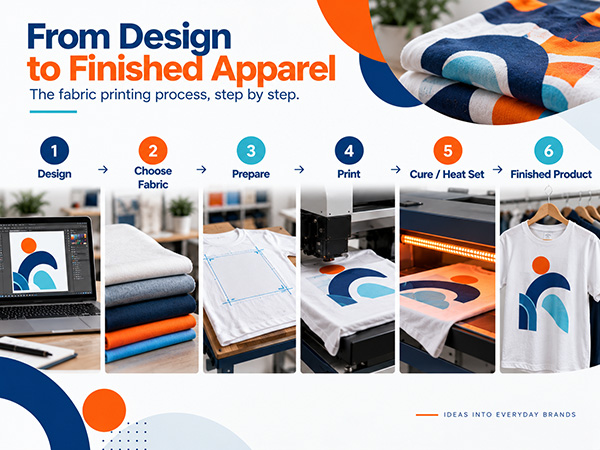
How to Print on Fabric Professionally: From Artwork to Finished Print
Knowing the methods is only half the job. How to print on fabric professionally comes down to matching the process to the project.
Start With the Fabric, Not the Machine
Before choosing a printer, check the fiber content.
Cotton and polyester may look similar from a distance, but they can require completely different fabric printing methods. Silk and wool introduce another set of considerations.
Then look at the order.
Are you printing 12 custom shirts or 1,000 uniforms? Large print runs can make screen printing attractive, while smaller detailed orders may suit a digital process better.
Finally, look at the artwork. Solid logos, photographs, gradients, and very fine detail do not all behave the same way.
Test the Artwork Before You Commit
A good print starts with a good file.
Use properly sized artwork and confirm the dimensions before production.
Vector files are useful for many logos and screen-printing separations, while photographic processes need enough raster resolution to stay sharp at final size.
Color deserves a check too. If color matching matters, do not rely only on what you see on a monitor.
For a larger order, a sample or proof lets you check print quality before producing every piece.
Printing Is Not the Final Step
Once the ink is on the fabric, production may still need curing, heat setting, steaming, washing, or drying.
These steps can greatly affect print durability.
A professional quality check should also look at color consistency, alignment, fine detail, adhesion, and overall finish.
For products that will be washed heavily, wash fastness and rubbing resistance matter too.
Screen Printing or Embroidery: Which Is Better for Custom Clothes?
There is no universal winner.
Embroidery is not technically fabric printing, but customers compare the two all the time.
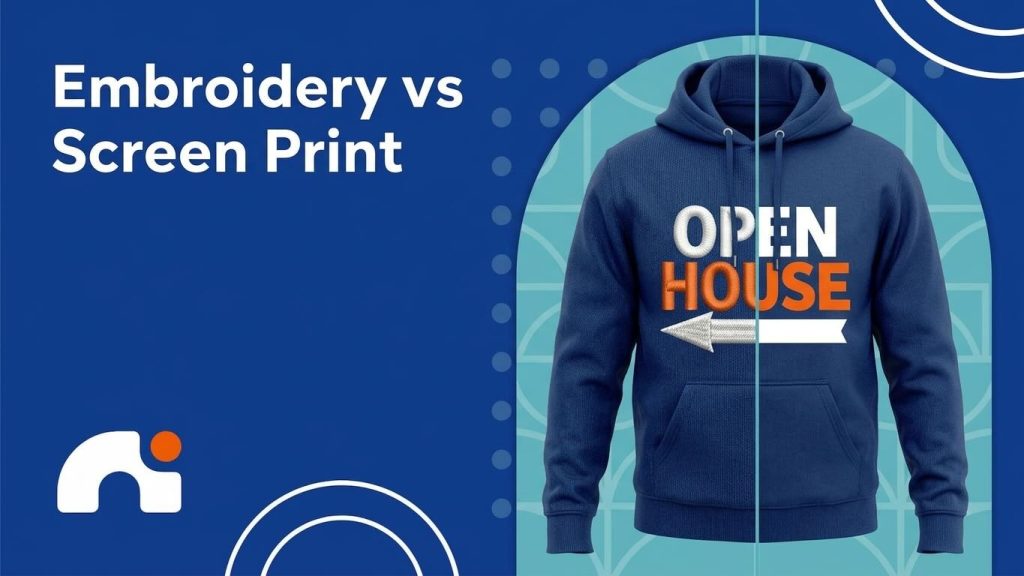
Screen printing usually makes sense for larger graphics and flat printed artwork, especially as quantities rise. Embroidery uses thread, so it creates texture and dimension.
That is why it is common on polos, jackets, uniforms, hats, and other branded apparel.
Our embroidery vs screen print guide goes deeper into how garment type, design size, quantity, appearance, and budget change the decision.
Conclusion
Now you know different types of printing on fabric; they exist because fabrics and designs don’t behave the same way. Before choosing a method, look at the fiber, artwork, quantity, feel, durability, and budget.
If you want to know how to print on fabric professionally, the best starting point is simple: choose the process around the job, not the other way around.