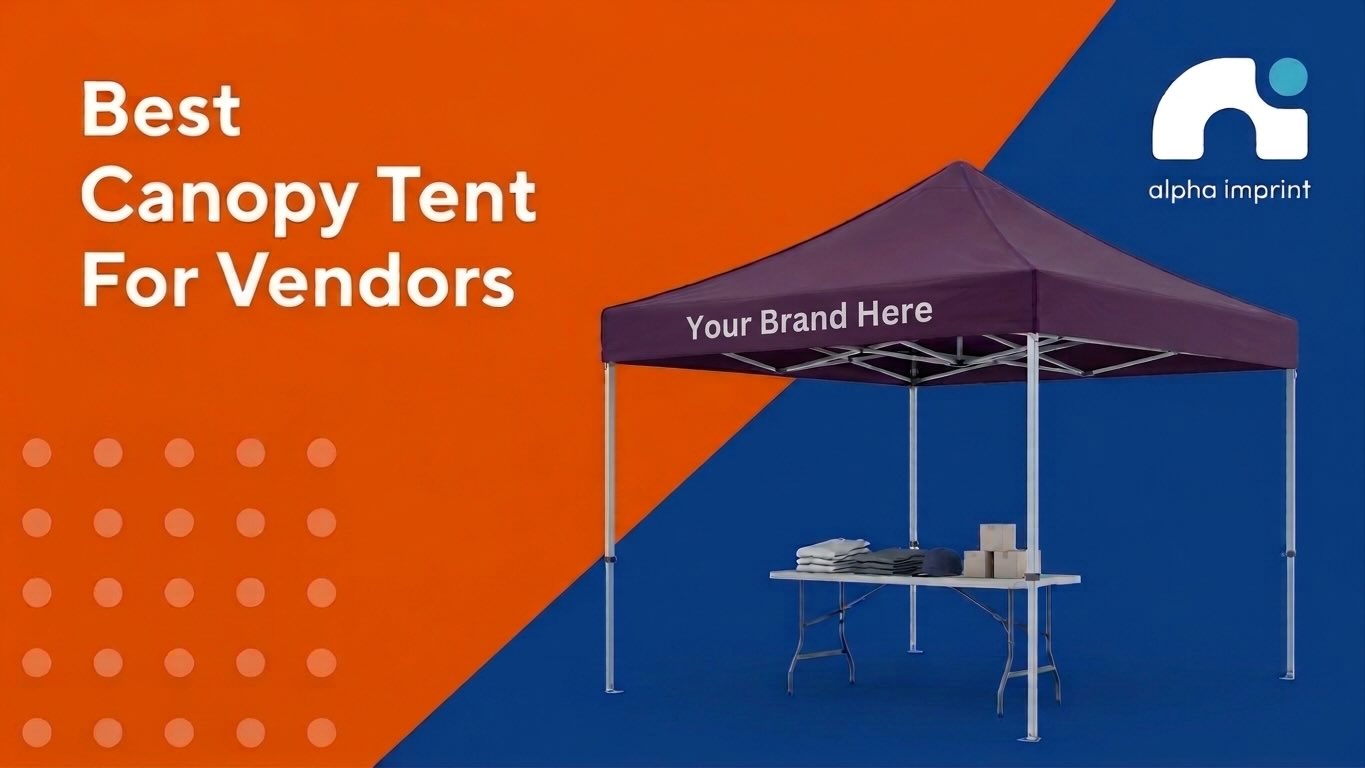
The best canopy tent for vendors has to do several jobs at once: protect products, define your selling space, carry your branding, and survive repeated setup.
The best pop up canopy for vendors depends on how often you sell, while the best canopy for farmers market use also has to fit booth rules, weather, products, transportation, and budget.
Quick Answer: What Should a Vendor Buy?
For most sellers, a commercial-quality, straight-leg 10×10 vendor canopy tent is the practical starting point. It fits many standard booth spaces and gives you predictable usable coverage.
The best vendor tents change with the job, though. Occasional sellers can put more emphasis on portability and price.
Weekly vendors should care more about frame quality, replacement parts, wall compatibility, and warranty support. Food businesses may also need specialized walls, ventilation, and service openings.
Match Tent Quality to Selling Frequency
If you’re testing markets for your first season, the best pop up canopy for vendors doesn’t have to be the most expensive option available.
Weekly setup is different. A commercial canopy tent that gets opened, transported, and packed dozens of times a year needs stronger joints, a better roof, and replaceable parts.
Year-round sellers should look at cost per season, not just purchase price. Replacing a recreational shelter every year can quickly erase the money saved upfront.
Evaluate the Supplier as Well as the Tent
When deciding where to buy canopy tents, compare more than the frame itself.
Look at replacement roofs, legs, joints, compatible walls, warranty terms, printing support, delivery, and after-sales help.
A vendor canopy tent will eventually show wear at connection points and fabric corners. Being able to replace one damaged component is much better than replacing the whole setup.
Alpha Imprint; Trusted Local Partner For Custom Tents in Houston
At Alpha Imprint, we help businesses coordinate their canopy with the rest of their signage in Houston, rather than designing each booth element separately.
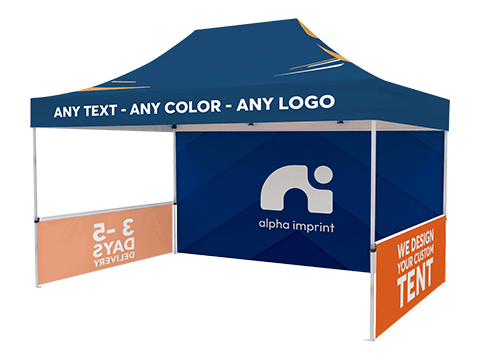
Our custom advertising tents in Houston currently include 10×10, 10×15, and 10×20 configurations with wall options.
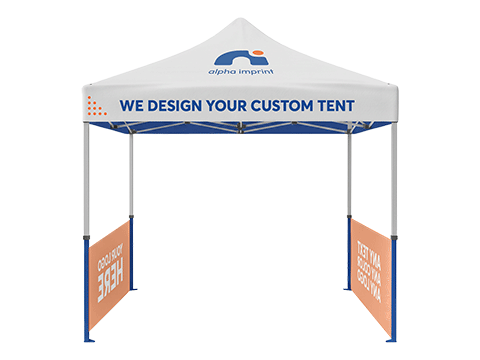
The 10×10 product page lists an aluminum hex frame, dye-sublimated canopy fabric, carry bag, sandbag option, half walls, full wall, and optional wheeled bag.
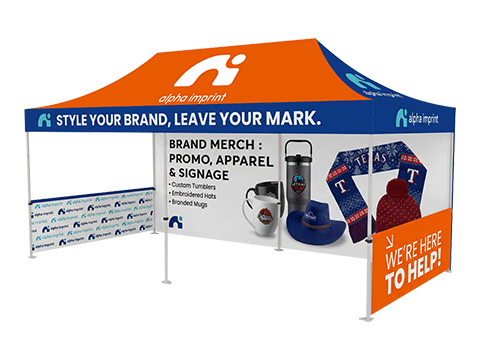
That lets us plan a custom vendor tent around logo placement, customer approach, banners, sidewalls, and the products displayed underneath.
Plan the Branded 10×10 Booth Before Ordering
A custom vendor tent works best when you plan the entire booth before ordering. A vendor tent 10×10 may be the best canopy for farmers market use for many sellers, but only if tables, storage, signage, and customer flow all fit comfortably inside.
Develop a Recognizable Visual System
Start with custom tent design ideas, but don’t treat every printable surface as empty space that needs filling.
On a custom vendor tent, the peak and front valance should quickly tell shoppers your business name and what you sell. Use back and side walls for supporting imagery or information.
A honey seller, flower grower, or handmade-soap brand can each use a completely different visual style without covering the booth in oversized graphics.
Fit Front, Back, and Side Graphics to the Frame
Before ordering graphics, check what size banner for a 10×10 tent and measure your actual frame.
A printed valance is part of the canopy. A separate hanging banner is not.
For a 10×10 vendor tent, check the actual printable width, banner height, grommet locations, viewing distance, and attachment points. An oversized loose banner can also catch more wind than a fitted graphic.
Arrange the Booth Around Products and Customers
Useful farmers market booth ideas start with how customers move through the space.
- For produce, use tiered crates without blocking sightlines.
- Flowers benefit from height.
- Packaged foods need clear prices and space for sampling.
- Craft sellers need enough browsing room to pick products up.
A good vendor booth display also creates a clear checkout area and keeps backup inventory out of the customer’s path.
We emphasize canopy coverage, organized displays, signage, tables, and customer flow.
Best Vendor Tents by Selling Situation
The best canopy tent for vendors depends more on selling conditions than on a brand name. Alpha Imprint’s current custom line gives vendors three useful footprint options, while its broader product catalog offers additional tent choices.
| Configuration | Best for | Main advantage | Main limitation |
| 10×10 custom tent | Standard markets, craft fairs, weekly vendors | Fits common booth footprints | Limited room for large displays |
| 10×15 custom tent | Larger product displays | More selling and storage space | Not accepted in every market |
| 10×20 custom tent | Larger operations and separated zones | Much more usable booth space | Requires a larger approved footprint |
| Broader Alpha tent catalog | Buyers comparing different formats | More choices for budget and use case | Specs must be checked item by item |
Best Budget Choice for a First Season
For a first season, use the Alpha catalog to compare simpler straight-leg options before investing in a larger custom system.
The best pop up canopy for vendors on a tighter budget should still have secure anchoring points, a usable carrying solution, clear dimensions, and available parts.
A low-cost vendor canopy tent isn’t a bargain if one broken joint makes the whole frame unusable.
Best Choice for Weekly Farmers Markets
For weekly selling, a branded 10×10 is usually the most practical place to start.
The best canopy for farmers market use should handle repeated setup and transport while staying within the organizer’s assigned footprint.
For example, Houston Farmers Market currently describes its outdoor vendor spaces as 10×10 and requires vendors to bring their own tent and weights.
A vendor tent 10×10 also leaves fewer surprises when you move between markets with standard booth dimensions.
Best Choice for Food and Sampling Vendors
A food vendor canopy may need a back wall, partial sidewalls, washable surfaces, ventilation, or a service opening.
A vendor tent with sides can help control sun and define prep areas, but walls can also affect ventilation and wind exposure.
Don’t order the enclosure first and ask about regulations later. Cooking vendors should confirm current health, fire, clearance, and ventilation requirements with the event and local authorities.
Best Commercial Choice for Frequent Events
If you’re selling several times each week, compare ownership cost rather than just purchase price.
A commercial canopy tent becomes a better investment when the canopy, walls, hardware, or other components can be replaced separately.
The best vendor tents should also give you enough branding flexibility to work across different events.
Best Portable Choice for Solo or Coastal Vendors
For an outdoor vendor tent that will be moved by one person, ask for actual packed weight and folded length before buying.
An aluminum frame may offer corrosion advantages, but don’t assume every aluminum model is automatically light enough for one-person setup.
Think about the whole trip: lifting the case into a vehicle, rolling it across a parking lot, adding canopy weights, and setting up without help.
How to Choose a Commercial-Grade Vendor Canopy
Compare a commercial canopy tent in this order: compliance, stability, weather protection, portability, replacement parts, warranty, branding, then price.
If the vendor canopy tent has unclear dimensions, missing compliance information, unavailable parts, or vague weather claims, don’t buy yet.
Choose the Correct Size and Footprint
A vendor tent 10×10 is a common market format.
Smaller 5×5 or 8×8 shelters can work for sampling or information stations. A 10×15 or 10×20 may suit larger displays or food-service zones where permitted.
The best canopy for farmers market use is the one that fits the assigned footprint after tables, inventory, staff, and customer movement are accounted for.
Examine the Frame, Legs, Trusses, and Hardware
For a commercial canopy tent, compare tubing, wall thickness, joints, trusses, footplates, and adjustment hardware.
Powder-coated steel can be economical and strong but heavier and susceptible to corrosion if damaged. Aluminum resists rust better and can reduce weight, depending on construction.
A straight-leg canopy is usually easier to keep within a defined vendor space and gives more predictable usable coverage.
Assess the Roof Fabric and Weather Protection
For an outdoor vendor tent, don’t judge durability by denier alone.
Look at coatings, seams, UV protection, roof tension, drainage, mildew resistance, and whether a replacement top exists.
A vendor canopy tent described as “water-resistant” isn’t automatically waterproof, and no portable canopy should be treated like a permanent storm shelter.
Compare Setup, Transport, Warranty, and Parts
The best pop up canopy for vendors should fit the vehicle and the people actually handling it.
Check packed dimensions, weight, wheeled-bag availability, adjustment controls, and recommended setup staffing.
The best vendor tents also make ownership easier later by offering compatible walls, roofs, hardware, and replacement components.
Safety and Compliance: Wind, Fire, and Food Service
Secure Every Leg and Prepare for Changing Wind
Ask the organizer how much ballast is required and which anchoring methods are permitted.
Different markets set different requirements.
For example, one market currently requires 30-pound weights on each leg, while another specifies a different minimum, which is why one nationwide ballast number isn’t appropriate.
Keep canopy weights attached during setup and breakdown. Walls increase wind exposure, so every outdoor vendor tent also needs a plan for shutting down when conditions become unsafe.
Verify Fire Labels and Food-Vendor Requirements
A fire-rated canopy still has to satisfy the rules of the specific jurisdiction and event.
Houston’s fire standards require certain tents and canopies to comply with local fire-code requirements, and its current food-related standard addresses flame-retardant fabric, exits, and cooking equipment.
For a food vendor canopy, confirm the extinguishers, the heat sources, the clearances, the ventilation, the exits and the sidewall rules. Permanent labels must be legible, and relevant certificates must be stored where an inspector can readily access them.
Sidewalls, Accessories, Setup, and Long-Term Care
A vendor tent with sides doesn’t necessarily need four solid walls. You could have a back wall, which helps with branding and sun protection.
Partial walls would keep the tent more open.
Clear vinyl would be good for visibility and mesh would be good for airflow. A food vendor canopy will probably need a special service opening.
For the vendor canopy tent kit, prioritize approved ballast, a transport bag, sturdy tables, compatible lighting, permitted stakes, and essential spares before adding decorative accessories.
Set up the frame and ballast first, add walls next, and bring products in last. Reverse that order during breakdown. Dry the fabric before storage and inspect seams, joints, and hardware regularly.
Those habits extend the useful life of an outdoor vendor tent and reduce the long-term cost of a commercial canopy tent.
Conclusion
For many sellers, the best canopy tent for vendors is a commercial-quality straight-leg 10×10, but the best vendor tents still depend on how and where you sell.
Match the commercial canopy tent to your products, frequency, weather, and branding. Before buying, verify event rules, invest in safe anchoring and choose a repairable system that can grow with your business.