Ordering custom shirts sounds simple until someone asks about heat transfer vs screen printing.
The answer depends on what you’re making. A hundred identical company shirts have different requirements from twenty jerseys with individual names. Fabric, artwork, durability and budget matter too.
In this “Screen Printing vs Heat Press” guide, we compare them and help you decide which is right for you.
Screen Printing vs Heat Press: Quick Comparison
Screen printing is generally the better option for larger runs of the same design. Heat press transfers are often the more convenient option for smaller runs, for artwork with lots of color or for garments that require individual names and numbers.
One thing worth knowing: a heat press is a machine, not a single printing method. The results depend on which transfer you use.
| Feature | Screen Printing | Heat-Press Transfers |
| Setup | Requires screens and artwork preparation | Requires prepared transfers |
| Order size | Often better for larger identical runs | Flexible for smaller or varied orders |
| Colors | Usually a separate screen for each spot color | Depends on transfer type |
| Artwork | Logos, bold graphics, halftones | Photos, gradients, names, numbers |
| Durability | Excellent when properly cured | Can be excellent when correctly applied |
| Feel | Depends on ink and coverage | Depends on transfer thickness and size |
| Fabric | Cotton, blends, compatible synthetics | Depends on heat tolerance and transfer |
| Personalization | Less convenient for changing artwork | Easier for individual designs |
| Cost | Setup becomes more economical across larger runs | Lower initial setup; pressing adds labor |
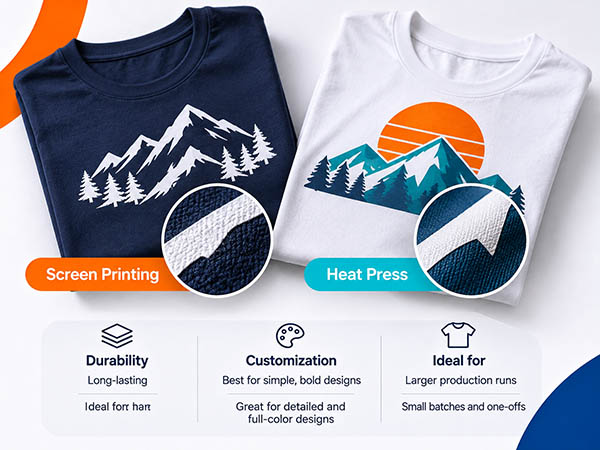
Neither method wins every category. What matters is how well it fits your project.
Alpha Imprint: Your Local Partner for Custom Apparel and Promotional Products in Houston
At Alpha Imprint, we work with Houston businesses ordering apparel for employees, schools, sports teams, company events, and promotional campaigns.
Sometimes customers arrive knowing exactly which printing method they want. Other times, they have a logo and a box of shirts in mind but aren’t sure how to bring everything together.
That’s where we can help. We look at the garments, artwork, quantity and budget before recommending a decoration method.
Local Screen Printing, Embroidery, and Branded Merchandise
When customers ask us to screen print in Houston, one of our first questions is whether every garment will have the same design.
Why? Because a consistent logo repeated across an entire order is exactly where traditional screen printing can be a strong choice.
But not every project calls for ink. Our embroidery in Houston services are worth considering for polos, caps, jackets and uniforms that would look better with stitched detail.
Also, if you’re planning a larger campaign, we can coordinate apparel with other promotional products in Houston to help your branding look consistent across clothing and other merchandise.
Custom T-Shirts and Hoodies for Teams, Events, and Workplaces
Imagine ordering shirts for a company volunteer day. Everyone needs the same logo, and you want the finished pieces to look consistent. Screen printing may be the obvious starting point.
For businesses ordering custom t-shirts in Houston, we can also consider heat transfers or other printing options when the design or quantity calls for them.
Hoodies introduce different considerations. Thicker fabric, seams and print placement affect the result.
Our custom hoodies in Houston can be decorated to suit the artwork, whether that’s a small chest logo or a larger back design.
The goal is simple: choose the finish that works with the garment, not against it.
How Screen Printing and Heat-Press Transfers Work
Both methods put designs on clothing, but they get there differently. Understanding the process helps explain the differences in price, feel and flexibility.
How Screen Printing Applies and Cures Ink
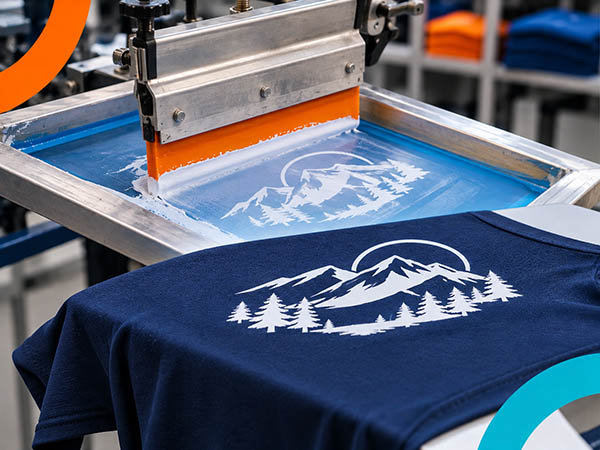
Screen printing pushes ink directly through a prepared mesh stencil onto the garment.
First, the artwork is separated by color. Each color generally needs its own screen, coated with emulsion and exposed to create the stencil.
A squeegee pushes ink through the open mesh. For multicolor prints, the screens must line up carefully so the finished artwork looks right.
Then the ink needs to cure.
Plastisol ink typically forms a layer on the fabric, while water-based ink can feel softer, depending on the material and formulation.
Here’s the important part: a print can look finished without being properly cured. If the ink hasn’t reached the necessary conditions, washing may reveal problems later.
What Is Heat Transfer Printing?
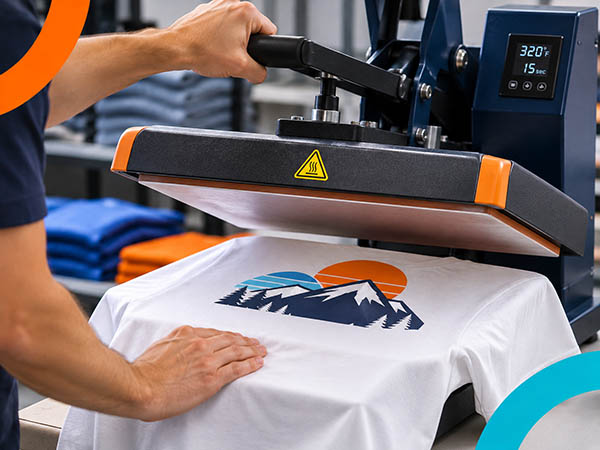
With heat transfer printing the design is created separately and then transferred onto the garment using a heat press machine.
There are a number of ways to do it.
- Heat transfer vinyl (HTV) is normally cut into lettering, logos and numbers. It’s ideal for simple designs and personalization, though standard HTV isn’t really suited to full-color photos.
- Digital transfers are useful for more complex artwork such as gradients. DTF transfers use printed film and adhesive to apply the detailed graphics.
- Sublimation works differently. Heat helps transfer dye into compatible polyester materials.
Each process needs the right temperature, pressure and pressing time. The fabric must also tolerate the application conditions.
So when someone says “heat press,” it’s worth asking which type of transfer they actually mean.
What Is a Screen Print Transfer, and How Does It Compare with an Iron-On?
Here’s where the terminology gets confusing.
A screen print transfer is made by screen printing ink onto special release material rather than directly onto a shirt. The design is then heat-applied later. Plastisol transfers are a common example.
This combines screen-print production with heat-press application.
What about a regular household iron?
For certain DIY iron-on materials, it can work. But an iron doesn’t provide the same consistent temperature and pressure across the artwork as a professional press.
For commercial orders, that consistency can make a real difference.
Screen Printing vs Heat Press: The Differences That Matter
Now for the questions most customers actually care about: Which costs less? Which lasts longer? And which will feel better to wear?
Cost, Setup, Quantity, Turnaround, and Reorders
- Let’s suppose a business requires 200 shirts, all with the same two-color logo.
Screen printing requires you to prep the screens first but once you’re actually in production, repeating that artwork is very efficient. The setup cost is then spread right across the whole order.
- Now imagine a team needing 20 jerseys with different names.
Prepping up separate screens for each name would be a real pain. Heat-applied lettering or transfers are often the way to go.
That’s the fundamental cost difference.
Still, quantity isn’t everything. The quote will be affected by artwork prep, print size, number of print locations, rush and potential reorders.
There’s no magic order size at which one method becomes cheaper every time.
Artwork, Colors, Personalization, and Print Size
For bold graphics and consistent brand colors, screen printing has a lot going for it.
A clean two-color logo? Great candidate.
A design with gradients, photographic detail, or different names on every shirt? A suitable digital transfer may be easier to produce.
Screen printing can also do detailed work via halftones. More colors and complex separations obviously affect the setup.
Think about the size as well. A large solid transfer is likely to be more apparent against the body than smaller lettering or a design with lots of negative space.
Durability, Care, and Common Failure Modes
You may ask, is there any difference between heat press and screen printing?
Sometimes, but it’s not a rule you can apply to every garment.
A properly cured screen print will withstand many washes. A professionally applied transfer will also last (depending on the fabric and the pressing instructions, of course).
Problems happen when those details are overlooked.
Under-cured ink may crack or wash away. A transfer applied with insufficient heat, pressure, or time may start peeling. Too much heat can damage the fabric.
For either method, check the care label.
Feel, Fabric Compatibility, Dark Garments, and Environmental Trade-Offs
Feel matters, especially when someone wears the same shirt all day.
A light water-based print may feel softer than a thick plastisol graphic. Likewise, a small transfer can feel quite different from a large, solid sheet of vinyl.
Fabric adds another complication.
Cotton, polyester, blends, fleece, nylon, and stretchy garments don’t all react to ink and heat the same way.
Dark polyester can also cause dye migration, where garment dyes discolor the printed design. Suitable low-bleed inks, transfer materials and temperature settings help manage this.
And which method is more sustainable? There’s no automatic winner. Water, energy, ink, transfer film, production waste, and how long the garment stays wearable all matter.
When working with an unfamiliar fabric, testing a sample is worth the effort.
Which Printing Method Should You Choose?
Use Screen Printing When:
You’re ordering a larger batch of the same shirts, hoodies or uniforms.
It’s ideal for company-branded goods, school events, staff wear and any campaign that needs a consistent look.
Bold logos and repeat orders are often the reason screen printing is so attractive. Just be aware that extra colors and extra print locations will affect the price.
Use Heat-Press Transfer When:
You need a small batch, detailed graphics or something different on each garment.
For photographic artwork, a full-color transfer can also be a convenient option.
Just confirm the transfer type and its compatibility with the clothing.
Combine Both Methods for Hybrid Orders
You don’t always have to choose one.
A sports team could screen print the same logo on every shirt, then heat-apply each player’s name and number.
That gives the team consistent branding without complicating personalization.
It’s also worth planning for replacement jerseys or new team members later.
When Embroidery Is the Better Decoration Method
Sometimes neither printing option creates the look you want.
A small stitched logo on a polo, cap, or jacket can look more appropriate than a large printed graphic. Embroidery adds texture and dimension, particularly on structured garments.
However, photographs, tiny lettering, subtle gradients, and oversized designs don’t always translate well into stitches.
Our embroidery vs screen print guide explores those trade-offs if you’re comparing a stitched finish with printing.
Other Fabric Printing Methods to Consider
Screen printing and heat transfers aren’t your only choices.
DTG printing can reproduce detailed, full-color artwork directly on suitable garments, often making it useful for smaller orders.
Sublimation printing is particularly effective on light-colored polyester and compatible coated materials.
DTF, meanwhile, is already part of the heat-transfer family.
Want to explore the alternatives? Our guide to different types of printing on fabric explains where each method fits.
Conclusion
Deciding between screen printing vs heat press is about matching the decoration to your artwork, quantity, and budget. Screen printing often makes sense for repeatable bulk orders. Heat transfers offer flexibility for smaller and personalized projects.
If you’re unsure, send us your design and garment details. At Alpha Imprint, we’ll help you choose an approach that fits your product.