


Trade show lead capture is not about collecting more names; it is about collecting the right context before the conversation fades.
Trade show lead capture is not just about scanning a visitor’s card or badge. Trade shows generate valuable leads when you have a system in place to properly capture and record information, understand audience needs, and follow up quickly.
In this guide, you’ll learn how to capture leads at a trade show, along with techniques on qualifying and converting leads into real sales opportunities.
How to Get Leads at a Trade Show? (Quick Answer!)
| Stage | What to Do | Key Insight |
|---|---|---|
| Pre-Show | Define qualified leads + run outreach | Book meetings before event = higher value |
| Booth Setup | Clear messaging, strong signage, useful incentives | Attract the right visitors, not everyone |
| Capture Tools | Use digital tools (QR, badge scan, CRM sync) | Capture data + context in real time |
| Qualification | Score leads (A/B/C) + add detailed notes | Context > contact info |
| Beyond Booth | Demos, side events, roaming team | High-value leads often happen outside booth |
| Follow-Up | Contact leads within 24 hrs (tier-based) | Speed + personalization drives conversion |
1. Start With Goals, Ideal Leads, and Pre-Show Outreach
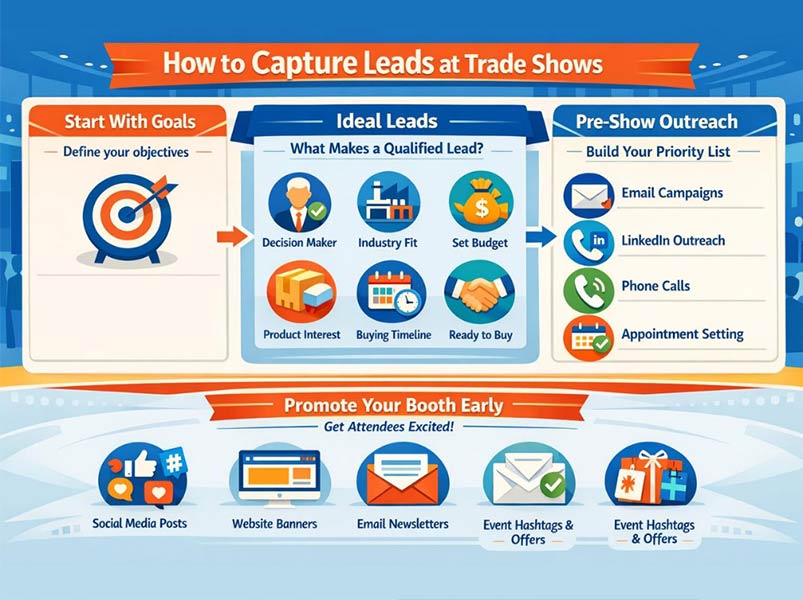
Define what a qualified trade show lead looks like
In trade show lead generation, the goal of “more leads” is very vague. First, define what qualified leads mean to you: role, type of company, budget, purchasing authority, product interest, and decision time.
For example, a better goal might be “50 qualified conversations” or “20 demo appointments with target accounts.”
Measurable goals start before the show floor opens, not in the middle of the booth crowd.
Run pre-show outreach before the event
If you’re asking how to get leads at a trade show, the answer starts before the show.
2-3 weeks in advance, build a list of registered attendees, current customers, prospects, and target accounts.
Then run a pre-show campaign with email, LinkedIn, calls, or calendar appointments.
Random leads are fine, but booked meetings are usually worth more.
Promote your booth before attendees arrive
Put booth promotion into practice: Post on LinkedIn, add a banner to your website, announce your booth number in your newsletter, and use the event hashtag.
If you have a demo, giveaway, free consultation, or limited offer, show it to event attendees before they arrive. Trade show marketing works when your audience knows in advance why they should come to you.
2. Make Your Booth Easy to Find, Enter, and Remember
Use booth design and signage to attract the right visitors
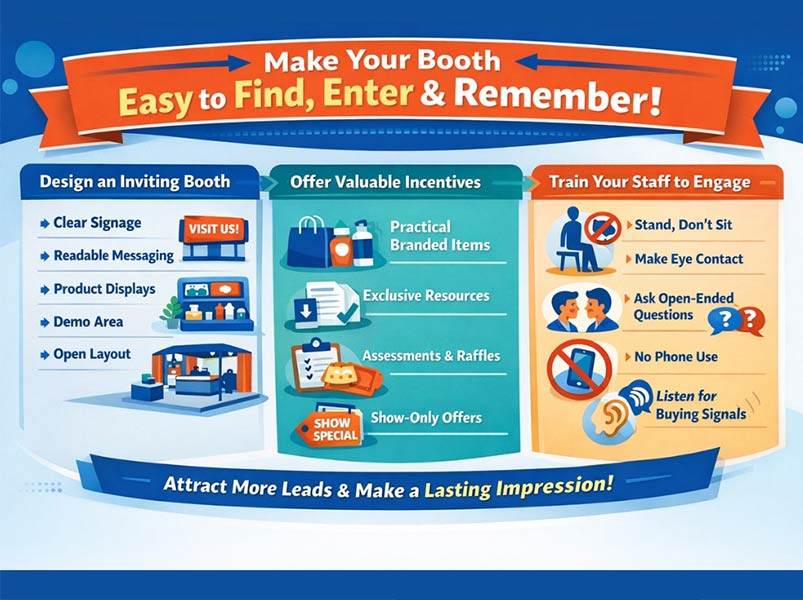
Booth design should tell in seconds who you’re helping and what problem you’re solving. A short message, visible product, demo space, and an open booth layout make entry easy.
To stand out in a crowded hall, using signage in Houston from Alpha Imprint can make your visual branding stand out more clearly and professionally.
Use useful incentives, not random freebies
A good giveaway attracts the right audience, not just freebie hunters. For better booth engagement, tie a useful item, free assessment, raffle, or trade show-specific offer to an action: a badge scan, short form, or demo booking.
Alpha Imprint offers tote bags, notebooks, drinkware, and apparel for businesses looking for promotional products in Houston.
Train staff to start real conversations
Booth staff should be familiar with the lead-capture workflow before the show starts. Sitting at a desk or looking at a phone kills attendee engagement.
It’s better to have them stand, make eye contact, and start with qualifying questions such as: “What challenge are you looking to solve right now?” or “When do you plan to make a decision?”
3. Use Digital Trade Show Lead Capture and Lead Retrieval Tools
Capture contact details with badges, QR codes, cards, and forms
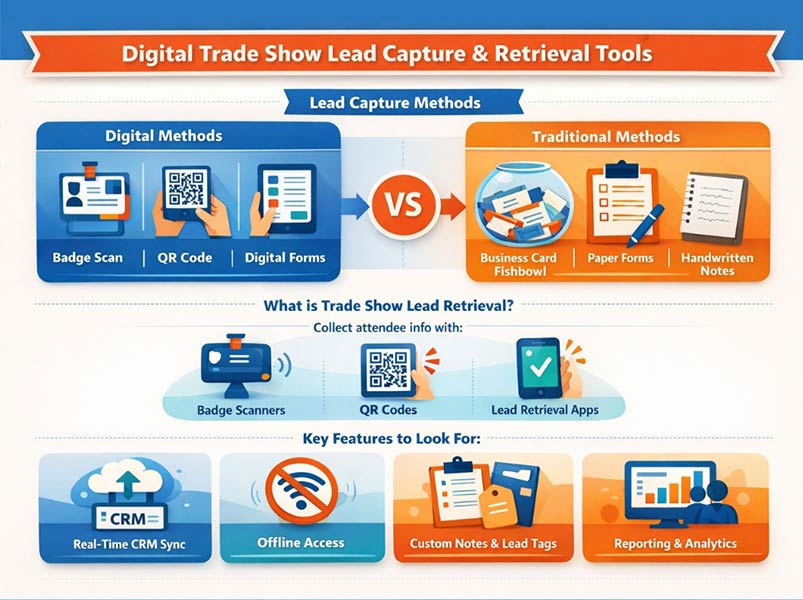
Trade show lead capture means capturing visitor information digitally in real time, not searching for leads on business cards and paper at the end of the day.
Digital lead capture can be done with badge scanning, QR code scanning, business card scanning, or tablet forms. What’s the point? Just a name and email aren’t enough; you also need to capture the need, the purchase time, and a conversation summary.
Understand trade show lead retrieval
Trade show lead retrieval typically means collecting visitor information through a certified event system, such as lead retrieval software, a badge scanner, a QR code, or a trade show app.
When an attendee badge is scanned, the registration information is entered into the system.
But event lead retrieval is more than just capturing a name; it also requires connecting the lead to your sales or marketing team.
For a professional presence, Alpha Imprint helps you complete your brand execution at trade show booths in Houston.
Choose tools with CRM sync, offline mode, and custom fields
A good lead capture tool shouldn’t just scan; it should make the information actionable. Look for lead capture software that supports CRM sync, offline mode, custom notes, lead tags, reporting, and team analytics.
Why is offline important? Because trade show booth Wi-Fi isn’t always reliable. CRM syncing also helps sales follow up while the conversation is still fresh.
4. Capture Context: Qualify and Score Leads on the Spot
Use an A/B/C lead scoring model
Not every badge scan should go into the same lead funnel.
For lead scoring, create a simple A/B/C model:
- Tier A is for hot leads: a decision-maker with a specific need, budget, or timeline.
- Tier B is for warm leads; interested but still need to be nurtured.
- Tier C is for cold leads, low purchase intent or more of a gift.
This separation helps sales teams reach high-value leads faster.
Add notes that sales can actually use
Conversation notes should be more specific than just “interested.” Good notes include pain points, product of interest, budget, current vendor, timeline, and next step.
Tools that have custom tags, customizable forms, or voice-to-text notes make this process faster.
For example, instead of “follow up,” write: “Needs badge scanners for Q3 event, comparing 3 vendors, wants pricing by Friday.” This type of context prevents generic follow-ups.
Keep giveaway entries connected to qualification
Collecting leads at trade shows can drive significant traffic with a giveaway, but if the form only asks for a name and email, lead quality will drop.
For giveaway entries, create a short form: a badge scan plus a qualifying question, or a QR code form with name, company, need, and timeline. Even for raffle entries, ask: “Are you making a purchase in the next 6 months?”
For more ideas, check our trade show giveaways product catalog.
5. Find Leads Beyond the Booth: Demos, Side Events, and Roaming Teams
Host demos, private meetings, or side events
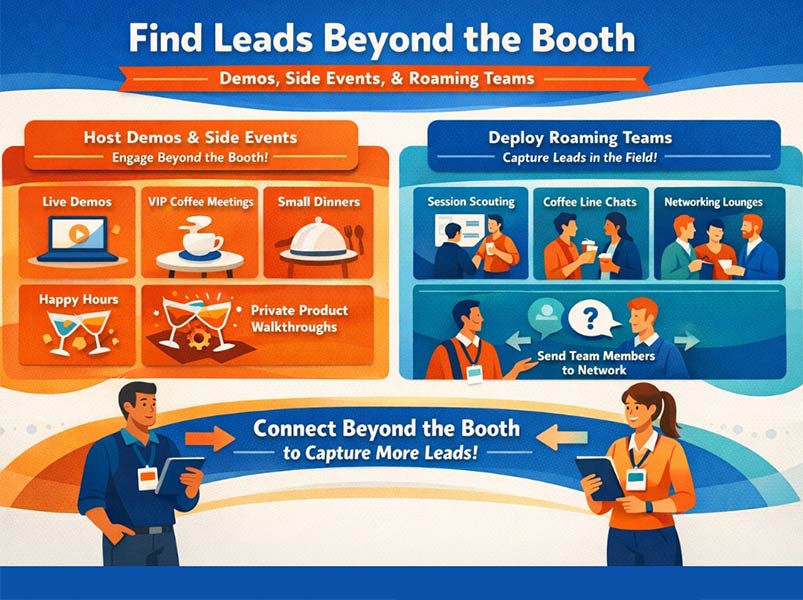
Not all good leads come from the aisles of the booth. Sometimes, a short live demo, a coffee meeting with a key client, a small dinner, or a private meeting is worth more than hundreds of random conversations.
For high-value prospects, a side event helps deepen the relationship and move the conversation from a quick introduction to a real needs assessment. Experts also emphasize that scheduling a meeting before or during the event improves lead quality.
Equip a roaming team to capture hallway leads
It’s not just the booth that matters on the trade show floor. Set up a person or two outside the booth for networking; at the coffee line; in educational sessions, lounges, or Q&As; or after speaking with speakers.
The key point? This team should use the same lead capture at events process: the same app, scoring, conversation notes, and clear next steps. The new tools are designed specifically to quickly capture, note, score, and sync leads.
6. Follow Up Fast, Measure ROI, and Avoid Common Mistakes
Send tier-based follow-up within 24 hours
The follow-up strategy should be fast and personal.
Follow up Tier A within 24 hours with a call, demo, or LinkedIn; Tier B with a case study and targeted email; and include Tier C in the nurture sequence.
This should be well-defined in your trade show planning.
Track performance and improve the next event
To measure trade show ROI, it’s not just about the number of scans. Look at total leads, qualified leads, Tier A leads, response rate, meetings booked, opportunities, revenue attributed, and meeting conversion rate.
Even message type, booth location, and types of signs can be optimized for your next event.
Avoid common lead capture mistakes
Avoid common lead capture mistakes such as indiscriminately scanning every visitor without qualification, relying on paper forms, handling manual data entry, neglecting meaningful notes, using generic follow-ups, and failing to track results, “a quiet but costly leak in your lead generation process.”
Conclusion
Success in trade show lead generation starts with early planning: attracting the right people, digitally capturing information, qualifying leads, following up quickly, and measuring results.
With these steps, you know how to capture leads at a trade show. When these steps become a repeatable system rather than a piecemeal effort, the trade show transforms from a one-time expense to a reliable sales channel.
FAQs
How to collect leads at tradeshows?
You can collect leads at trade shows by using badge scanners and QR code forms, taking notes during conversations, and scoring them based on their potential.
What sells best at trade shows?
Practical items like demos, short-term offers, free consultations, and relevant giveaways work better than random giveaways.
Are trade shows declining?
Not necessarily; trade shows are still effective, but their success depends on lead capture at the trade show and timely follow-up.
What to avoid during an exhibition?
Avoid aimless scanning of everyone, paper forms, sitting in the booth, using the phone, and generic follow-up.
What information should you collect from trade show leads?
Record name, company, role, primary need, budget, timeline, product interest, decision level, and next step.
How soon should I follow up after a trade show?
For hot leads, follow up within 24 hours via email, phone, LinkedIn, or a demo invitation.