


If you do not have trade show planning, even a good booth may only generate expenses, not leads.
Trade shows remain among the most effective channels for generating leads and increasing brand visibility, but without regular trade show planning, they can easily become a costly, ineffective expense. Because it’s not just about attending the event; planning, execution, and follow-up all affect the outcome.
This guide is intended to be complete and practical guide that’s meant to teach you how to prepare for a trade show.
How To Prepare For a Trade Show? (Quick Answer!)
| Phase | Key Actions | Purpose |
|---|---|---|
| Goal Setting | Define clear goals & KPIs (leads, sales, brand awareness) | Align all decisions with measurable outcomes |
| Audience Identification | Identify target audience (buyers, decision-makers, etc.) | Tailor messaging, demos, and giveaways effectively |
| Budget Planning | Set a realistic budget (booth, travel, marketing, logistics) | Avoid hidden costs and allocate resources strategically |
| 3–6 Months Before | Book booth, finalize event, design booth, set objectives | Establish foundation and avoid delays |
| 1–3 Months Before | Prepare marketing, landing pages, giveaways, logistics | Execute promotional and operational plans |
| Final Weeks | Train staff, test tools, confirm shipping, finalize checklist | Ensure readiness and eliminate last-minute risks |
| Pre-Show Setup | Prepare materials, brief team, finalize logistics | Ensure smooth setup and clear roles |
| On-Site Execution | Test booth setup, engage visitors, capture leads in real time | Maximize engagement and lead generation |
| Post-Show Follow-Up | Follow up within 24–48 hours, nurture leads, measure ROI | Convert leads into clients and improve future events |
| Booth Strategy | Use clear messaging, good layout, interactive elements | Attract attention and encourage interaction |
Alpha Imprint: Your Local Houston Partner for Promo Items & Trade Show Signage
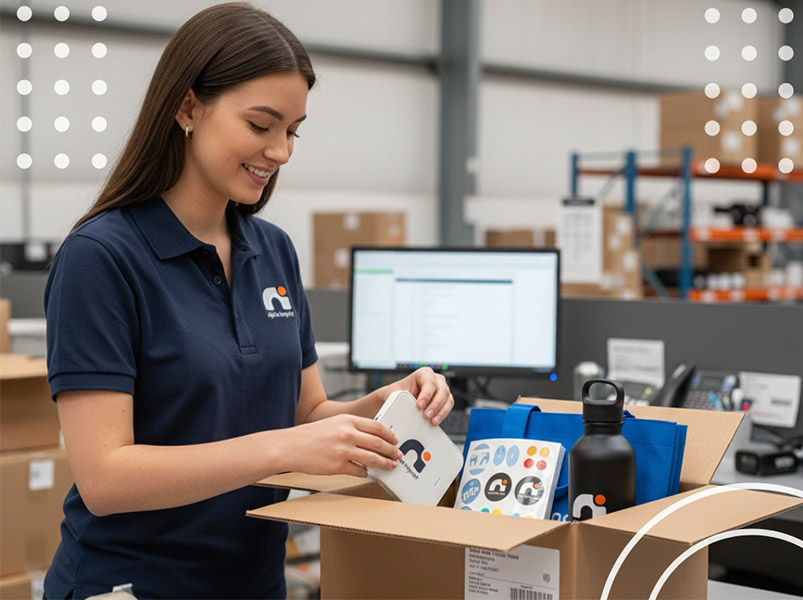
Using several suppliers for your trade show needs may not always help your brand succeed.
Alpha Imprint’s advantage is that it can streamline the process, from designing and implementing signage in Houston to preparing trade show booths in Houston and selecting promotional products in Houston that truly fit your brand identity.
When your booth, banners, displays, and giveaways all match from the beginning, your brand looks more professional and unified. You spend less time coordinating with different teams and get more attention at the event.
If you want your booth to stand out, working with a local team that knows both printing and trade shows can make a big difference.
What Is Trade Show Planning & Why It Matters
Trade show planning means not leaving your trade show presence to chance and improvisation. From event selection and budget to booth design, team training, lead capture and follow-up, everything should be thought out in advance.
When this path is structured, a trade show is not just an expensive presence; it can lead to better networking, increased brand visibility and measurable ROI.
The difference between poor planning and effective planning usually becomes apparent very quickly: one moves forward with stress, hidden costs, and scattered leads; the other moves forward with a clear goal, systematic execution, and an exhibition checklist that leaves nothing out.
In practice, a good trade show strategy is what turns an event from “just attending” to “getting results”.
How to Prepare for a Trade Show: Step-by-Step Strategy
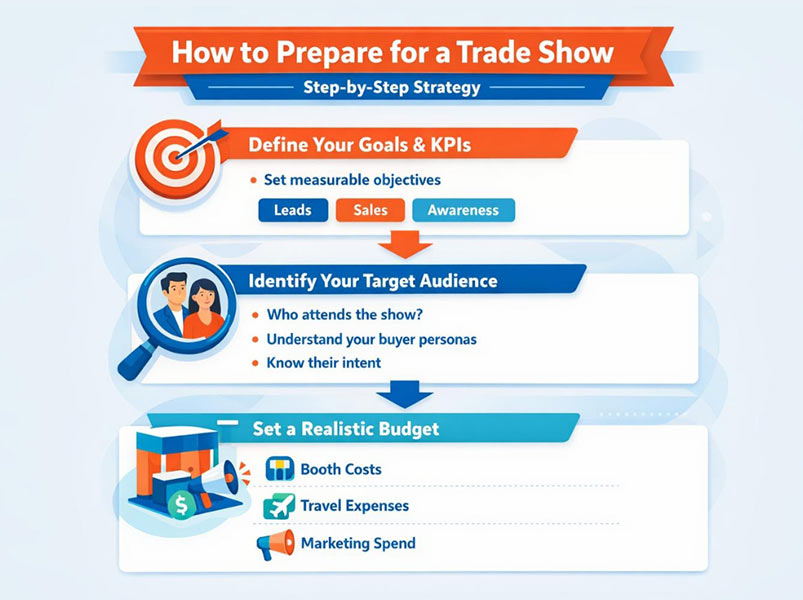
Define Your Goals & KPIs
If you want to know how to prepare for a trade show, the first step is to know exactly what results you are looking for.
How many leads do you want? Is your goal direct sales? Or do you want to increase brand awareness? KPIs should be measurable; for example, the number of leads, the number of meetings, cost per lead, or conversion rate after the event.
When trade show goals are clear, other decisions also make more sense, from booth size to staffing and message type.
Identify Your Target Audience
Not everyone who enters the hall is your real audience. You need to know who will be standing in front of your booth: a buyer, a decision-maker, or someone gathering information?
Knowing your audience means understanding the industry, their intent, and their behavior. This knowledge will help you choose the right text, demo, promotional gift, and even the booth team’s tone.
When you don’t know your audience, execution is compromised and the right message doesn’t reach the right person.
Set a Realistic Budget
The next important part is to set a realistic trade show budget. Don’t just set a budget for the booth; consider travel, accommodation, marketing materials, shipping, tech, staff, and hidden costs.
Many exhibitors make this mistake and only come up with real numbers halfway through. A good budget should align with your goals; that is, if lead generation is more important to you, your spending should go more towards those areas, not just on the surface.
This is where good planning prevents nasty surprises.
Trade Show Planning Timeline: When to Start & What to Do
3–6 Months Before
During this time, you should finalize the event, book booth space, set a budget, and decide on your message, booth design, and key objectives.
Many new trade show timelines recommend starting serious planning at least 3 to 6 months in advance, as delays at this stage will affect printing, manufacturing, shipping, and even hotel selection later on.
This section is the main pillar of the trade show planning timeline.
1–3 Months Before
Now it’s time for the execution details. Your marketing campaign, landing page, emails, giveaways, shipping plan, and vendor coordination should all be finalized.
If this stage is delayed, costs will typically increase and options will be more limited.
For many exhibitors, this is the most important part of the pre-show checklist, as both the advertising and logistics really get serious.
Final Weeks
The final weeks are not the time for big decisions; they are the time to check and close out the details. Staff training, screen testing and lead-capture tools, confirming shipping times, checking packing lists, and reviewing the show-day scenario all need to be completed.
Any small delay here can ruin the day of the show. That’s why a good checklist for a trade show is more valuable than ever.
Checklist for Trade Show & Exhibition Success
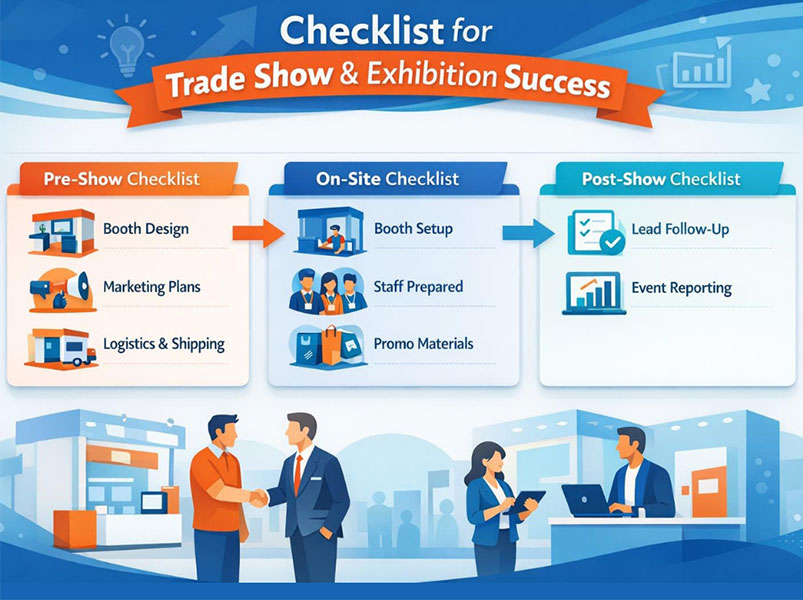
Pre-Show Checklist
For the checklist for trade show, before the show starts, the following should be completed:
- Goals and KPIs are defined.
- Booth design, key message, and CTA are finalized.
- Transportation, accommodations, shipping, and the move-in schedule are finalized.
- Printed materials, giveaways, lead capture tools, and demos are ready.
- The booth team is briefed and knows who will be doing the greeting, demo, and lead handling.
This section for trade shows usually focuses more on lead generation and traffic.
On-Site Checklist
On the day of the show, the exhibitor checklist should be quick and easy to scan:
- Booth boundaries are checked against the floor plan.
- Lighting, screens, internet, power, and graphics are tested.
- Brochures, cards, forms, and lead retrieval tools are in place.
- Keep the entryway clear and the CTA legible from the hallway.
- Have the team do a short review before the hall opens.
In exhibitions, this stage sometimes relies more on structured presentations and product demonstrations.
Post-Show Checklist
After the event, here is the important part of the checklist for the exhibition:
- Categorize and follow up on leads within 24-48 hours.
- Review cost, number of leads, lead quality, and engagement.
- Record packing, return shipping, and potential damage.
- Have the team do a short debrief: what went well and what needs improvement.
This is the part that connects a good presence to real results.
Trade Show Booth Design & Branding Strategies
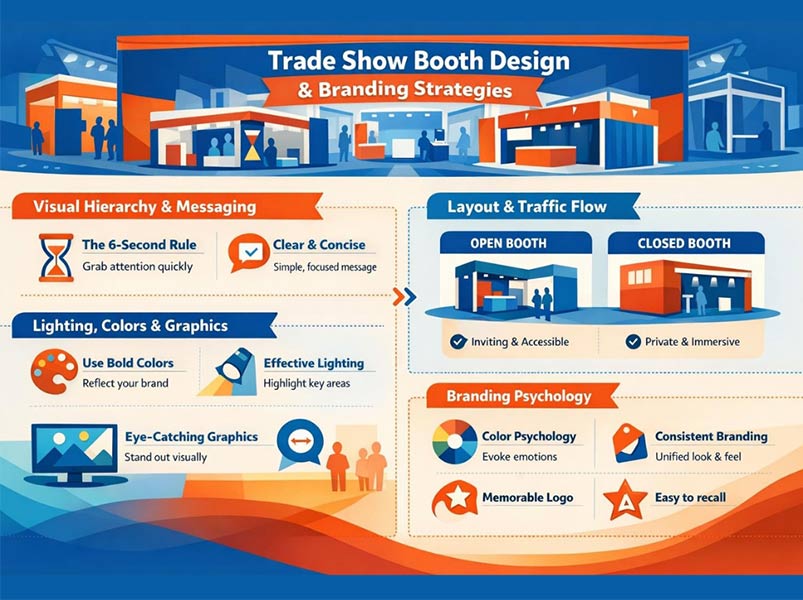
Visual Hierarchy & Messaging
In trade show booth design, visitors aren’t going to read long lines of text. They’re usually just looking to figure out what you do and why they should stop by in the first few seconds.
So, the headline should come first, followed by a short description, and then the CTA. If this hierarchy is messed up, the message and the conversation get lost.
The simple rule is: say less, say it more clearly, and make yourself understood from a few steps away.
Layout & Traffic Flow
A good design isn’t just pretty; it should also make it easy for people to move around. In trade show booth design, an open layout is usually better for quick entry and initial interaction, because the audience doesn’t feel like you’ve put up a wall in front of them.
A more closed layout can be good for demos or more serious meetings, but if it’s too closed, it can turn people off. It’s best to divide your booth into light zones: a section for stopping, one for showing, and one for talking.
Lighting, Colors & Graphics
Lighting and color aren’t just for aesthetics; they affect the brand’s feel and the quality of attention. Lighting should highlight the product, logo, or demo area, not just illuminate the entire space.
Colors should also do two things at once: be consistent with the brand and convey the right psychological message. Good graphics should also be bold, clean, and legible from a distance.
When these three things sit together well, your booth doesn’t just look pretty; it also feels professional and trustworthy.
Trade Show Booth Ideas That Attract & Convert
Many trade show booth ideas are just good for cluttering up the space, not for getting results. A truly effective idea should both grab attention and open up a way to start a conversation.
That’s why booths that have an interactive element, like a touchscreen, a short demo, a clear theme, or a small, tactile experience, usually perform better than booths that are purely decorative.
Among creative booth designs, those that pull visitors out of spectator mode and give them something to do sell the most.
A good example? A booth with a clear theme, showing the product in a real-world scenario, and putting a CTA right in front of the audience. For example, “Try it,” “Scan,” or “Make an appointment for a demo.”
This design model connects attention directly to interaction. In practice, the best ideas aren’t just the ones that are weird; they’re the ones that make people pause, start a conversation, and then take the visitor one step further.
Trade Show Giveaway Ideas to Drive Booth Traffic
The power of trade show giveaways isn’t just that they’re free; it’s that they encourage people to stop, interact, and remember your brand. But here’s a common mistake: handing out a bunch of cheap giveaways that leave no one remembering the brand.
In 2026, a more effective approach is to focus on usefulness and quality rather than quantity. Promotional giveaways work best when they’re either useful in everyday life or are so good that they won’t be thrown away quickly.
Therefore, a good giveaway should fit both the audience and the booth’s purpose. For general traffic, a simple and functional item will suffice.
For better leads, a higher-quality giveaway makes more sense. This tiered approach both spends budgets more wisely and doesn’t compromise lead quality.
Tips for Trade Show Exhibitors: Maximize Engagement & Leads
Staff Training & Behavior
Within the discipline of effective trade show planning, one principle stands paramount: booth team readiness must remain at the forefront. The initial encounter should be warm, succinct, and effortless, never overbearing, never detached, because “the first impression quietly shapes every interaction that follows.”
The team should know who is greeting, who is giving a demo, and who is leading the conversation. Practicing short openers and role-playing before the event really makes a difference.
Lead Qualification Techniques
For better lead generation, ask short, targeted questions: What solution are you using now? What challenges do you have? When do you make a decision? Just a few questions will help you focus your time on the right people, not just on every badge scan.
Engagement Tactics
Smiling alone isn’t enough to keep attention. A live demo, a short challenge, a light contest, or a simple on-screen interaction can increase dwell time. The best tactics are those that engage the visitor and pave the way for lead capture right there.
During the Event: How to Execute Like a Pro
Booth Setup & Final Checks
The morning of the show is no time for improvisation. In a trade show booth setup, you need to do a quick but thorough check of the lighting, screen, internet, power, graphics, and entryway before the hall opens.
If something isn’t legible from the hallway or the booth still looks crowded, fix it right away; you won’t have time for it later.
Attracting Visitors
On the floor, people don’t wait for a formal invitation. A quick question, a ten-second demo, or a clear hook works much better than standing around passively.
This is where booth setup is more than just decor; it should help grab attention quickly and start a conversation easily.
Managing Leads in Real Time
Don’t leave managing trade show leads to the end of the day. Capture, tag, and briefly qualify leads immediately after each conversation so that things don’t get mixed up later.
Digital tools, badge scans, and short notes help you decide who needs immediate follow-up and who just needs a general call.
Post-Show Follow-Up Strategy That Converts Leads into Clients
Immediate Check-In (First 48 Hours)
The most important part of selling starts the moment the show ends. In trade show follow-up, the first 24 to 48 hours are important, because the conversation is still fresh in the lead’s mind.
The first message should be short, personalized, and relevant to the conversation; not a generic email sent to everyone the same way.
If someone has a question about pricing, a demo, or a project schedule, they should get an answer right away. Speed at this stage isn’t just a sign of discipline; it’s also a sign of a serious brand.
Lead Nurturing Campaigns
Not all leads are ready to buy right away. That’s why lead nurturing should be staged: one group needs educational content, another needs a case study, and another needs an invitation to a meeting.
The goal is to keep the relationship from cooling off after the event. Good nurturing means consistent but intelligent follow-up, not a bunch of irrelevant messages.
Measuring ROI & Performance
If your next event is going to be better, you need to know exactly what worked. Lead count, lead quality, response rate, meetings booked, and potential revenue must be tracked. This is where follow-up goes from a simple execution task to a decision-making tool.
Creative Vendor Booth Ideas to Stand Out among Competitive Events
The real difference between dozens of similar booths is in the details. Creative vendor booth ideas work when the booth isn’t just “pretty,” but creates a reason to stop.
A short micro-experience, timed demo, spatial storytelling, or an element of surprise can grab attention from the aisle and turn it into a conversation.
In a good vendor booth strategy, the booth theme, team demeanor, lighting, display, and CTA all tell a single story. It’s this coordination that transforms a booth from a typical setup into something that’s seen more quickly, remembered more often, and more likely to engage.
In competitive markets, this kind of differentiation usually doesn’t come from a bigger budget; it comes from smarter choices.
Conclusion
Ultimately, what makes a trade show successful isn’t just about showing up; it’s about trade show planning. When you carefully plan your goals, budget, booth, team, and follow-up, you’ll be less likely to be surprised on the day of the event.
It’s knowing how to prepare for a trade show that helps each subsequent trade show run more smoothly, less stressful, and more productive.
FAQs
How do I prepare for a trade show?
For an exhibition, you need to prepare the goal, budget, booth, team, lead-generation tools, logistics, and follow-up in advance, in stages.
How long does it take to plan a trade show?
Usually, serious planning starts 3 to 6 months in advance so that the booth, marketing, logistics and team can be prepared without pressure.