



Many customers need a real vinyl vs. PVC banners comparison, this is the question they ask the printing house before ordering a banner: What is the real difference between vinyl and PVC banners?
Many people planning to order advertising banners often wonder: what exactly is the difference between vinyl vs PVC banner? These two terms are often used interchangeably in the printing market, which can cause some confusion.
In this article, we’ll look at the durability, print quality, weight, cost, and uses of each to help you make an easier choice.
What Is The Difference Between Vinyl & PVC Banners? (Quick Answer!)
| Aspect | Vinyl Banner | PVC Banner |
|---|---|---|
| Material | Usually PVC coated on polyester mesh (often called “scrim vinyl”) | Pure or thicker PVC-based material |
| Weight & Flexibility | Lighter and more flexible | Heavier and less flexible |
| Durability | Good, but slightly weaker in strong wind or harsh conditions | More durable; better tear and stretch resistance |
| Print Quality | Often very vivid colors and good visual impact | Also good, but depends more on surface coating |
| Typical Use | Indoor signage, trade shows, portable or temporary banners | Long-term outdoor banners, construction sites, windy areas |
| Installation | Easier to carry, move, and install | Harder to transport due to weight |
| Cost | Usually similar to PVC; depends on thickness and print | Similar pricing; durability may give better long-term value |
What Are Vinyl and PVC Banners?

Material Composition Explained
When it comes to advertising banners, many people don’t know the real difference between vinyl banners and PVC banners. In fact, the main material in most of these banners is polyvinyl chloride (PVC), a durable plastic polymer very popular for outdoor printing.
In most cases, what is called vinyl is actually a scrim banner material: a layer of PVC placed on a reinforced polyester mesh. This structure, called reinforced banner fabric, provides high tear resistance. These banners also vary in thickness, such as 10oz, 13oz, or 18oz.
Are Vinyl and PVC the Same Thing
At first glance, PVC vs vinyl banner may seem like two different products, but the reality is a little more complicated.
Vinyl is a general term for vinyl-based plastics, while PVC is a specific type. That’s why many vendors use the two terms interchangeably when describing banner material types.
So, when you’re choosing between vinyl or PVC banner, you’re often dealing with a similar base material.
OK, now it’s time to compare these two types of banners in terms of durability and weather resistance.
Durability & Weather Resistance Comparison
Outdoor Performance
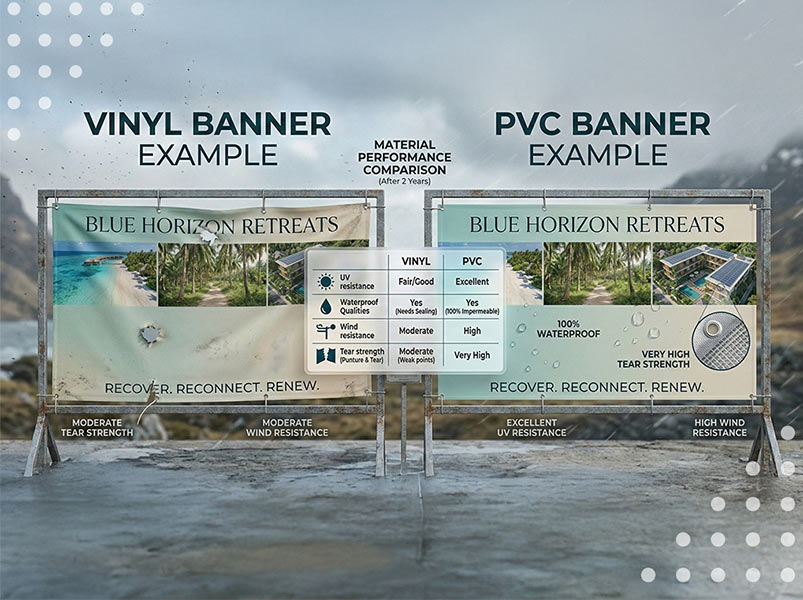
When it comes to outdoor use, the comparison of vinyl banners vs PVC banners becomes even more important. Both types of banners are weather-resistant because they are completely waterproof and moisture does not damage them.
In addition, these banners are usually printed with UV-resistant inks so they do not fade in direct sunlight.
For example, imagine a store on the side of the street installing a banner for a seasonal sale; if the banner is made of outdoor vinyl with a tear-resistant structure, it is highly resistant to strong winds and to being stretched over a metal frame.
For this reason, many of these banners can last for several years outdoors.
Indoor & Short-Term Applications
For short-term indoor applications, the choice between vinyl or PVC banner usually comes down to ease of use and cost.
For example, at trade shows, many booths use these banners as backdrops or temporary signage. Because this type of indoor banner material is lightweight and rolls up easily, it can be folded up and stored for later use after the event.
For example, at a conference or store opening, the quick set-up and easy assembly of these banners is a big advantage.
Print Quality & Visual Performance
In terms of print quality, the vinyl vs PVC banner comparison gets a little more interesting. Both materials have relatively smooth surfaces, but the coating type and texture can affect print results.
Banners with a smoother, more uniform surface absorb ink more evenly, making colors appear more vivid and clear. For this reason, in projects where branding is of great importance, the quality of the banner’s surface is crucial to image clarity and text readability.
On the other hand, the finish type is also important. Some banners are printed with a matte coating to reduce light reflection and are suitable for bright spaces. In contrast, a glossy finish makes colors appear deeper and more impressive.
Therefore, when choosing between vinyl and PVC banners, consider the installation environment and the level of visual impact expected, especially if the goal is to attract attention in advertising.
OK, let’s see of these two banner material types stack up when it comes to weight, flexibility and installation.
Weight, Flexibility & Installation
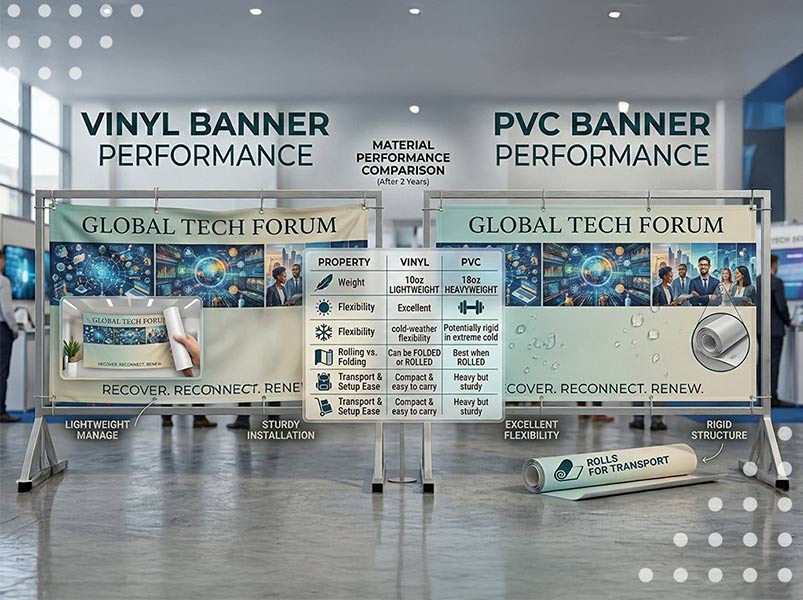
Weight and flexibility are factors that come into play very quickly when installing a banner. For example, lighter banners like 10oz are usually easier to carry and are a good option for short-term installations.
In contrast, thicker banners like 18oz weigh more but are more resistant to stretching and pressure.
Now, a common question: is a heavier banner always better? Not necessarily. If you plan to move the banner around a lot, less weight makes the job much easier.
There are also important details when it comes to installation. Many banners are manufactured with grommets (metal rings), hemming, or pole pockets to make mounting on a frame or wall easier.
Wind slits or even mesh banners are sometimes used to reduce wind pressure. It is also often recommended to roll up the banner, not fold it, to avoid damaging the printed surface.
Cost Comparison & Long-Term Value
When it comes to cost, many businesses focus only on the initial price. But you really need to do a deep banner pricing comparison. Cheaper banners may cost less initially, but if they tear or fade after a few months, you will have to pay again.
For example, imagine a restaurant installing an outdoor banner. If they choose a poor banner, they may have to replace it every year. In contrast, a higher-quality banner may last several years. This is the same long-term perspective on signage investment.
The story gets even more interesting for high-volume printing. Bulk orders usually lower the unit price. But the important question is: is the cheapest option always the best? In many advertising projects, the answer is “no.”
At Alpha Imprint, you can get banners Houston businesses and beyond trust at affordable prices. Years of providing signage Houston services have proven to us that quality is the number one factor in producing reliable signage solutions, and we deliver our products at affordable prices! So, don’t hesitate, request a quote today!
Environmental Impact & Sustainability
From this perspective, comparing vinyl vs PVC banners is a bit challenging. This is because PVC is not easily recycled and its manufacturing process can have environmental impacts.
This is why discussions about recyclable PVC and proper waste management have become important in the printing industry.
But there is an interesting point. Sometimes, the longer the banner, the less often it needs to be replaced. That is, instead of several disposable banners, you use one more durable banner.
This is exactly the approach of sustainable signage. A longer product lifespan can reduce material waste, although the environmental impact of PVC production remains a topic of ongoing discussion in the printing industry.
If someone is looking for a greener option, some companies are turning to eco-friendly banner materials. It is also recommended to deliver the banners to industrial recycling centers after use.
Pros and Cons of Each Material
Vinyl Banner Pros & Cons
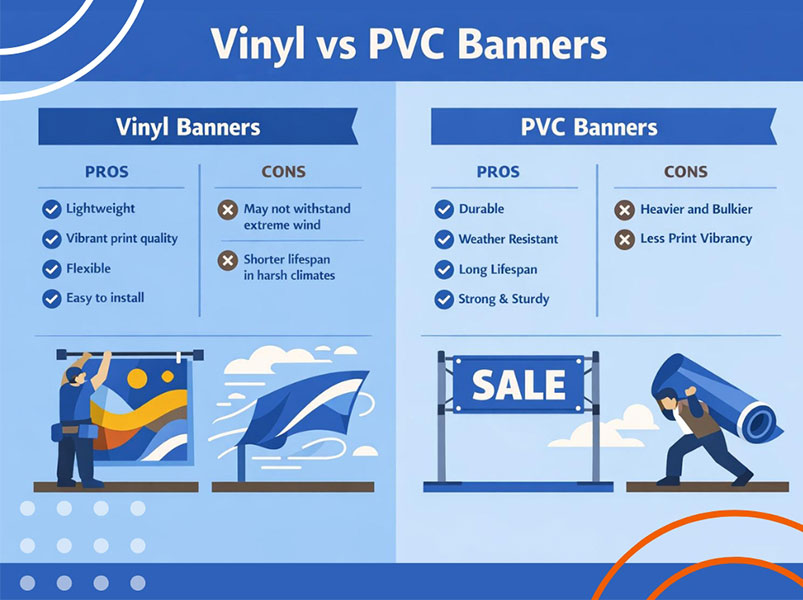
Compared with PVC banners, vinyl banners are very popular due to their lower weight and greater flexibility. They are easy to install, and even one person can easily install them on a wall or frame.
Also, the printing on these banners is usually very vivid and impressive.
But when choosing a vinyl or PVC banner, it should also be noted that vinyl banners may be less durable in very strong winds or harsh weather conditions.
PVC Banner Pros & Cons
In comparison, PVC vs vinyl banners, PVC banners are better suited for heavy, long-term projects. A heavy-duty PVC banner is usually thicker and therefore shows high resistance to tearing and stretching. Therefore, it is a reliable option for outdoor installations and in windy areas.
However, these types of banners are heavier, harder to transport, and may become less flexible and more brittle in very cold weather and during freezing conditions.
How to Choose Between Vinyl vs. PVC Banner
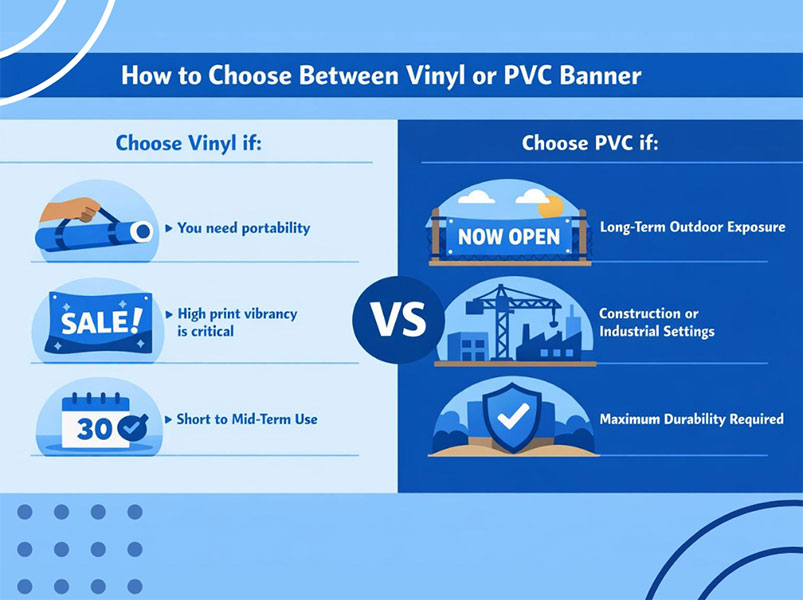
Choosing between vinyl or PVC banners always comes down to a simple question: where will the banner be used and for how long? Many businesses consider this very point when comparing vinyl vs PVC banner.
Choosing between vinyl or PVC banners ultimately comes down to a simple question: where will the banner be displayed and for how long will it remain in place? As the saying goes, “the right material reveals itself once the setting and purpose are clear.“ Many businesses keep this exact consideration in mind when evaluating the vinyl vs PVC banner decision.
If you need a banner that’s easy to move, vinyl is usually the better option.
For trade shows, temporary events, or in-store promotions, vinyl banners are often preferred because they’re lighter and have brighter colors. Plus, if you’ll be taking the banner down and putting it back up often, vinyl’s flexibility makes that much easier.
In other cases, the choice changes. If your banner will stay outdoors for months or even years, PVC is usually the better pick. It’s more durable, which matters a lot in places like construction sites or windy spots.
A simple checklist:
Portable? → Vinyl
Highly impressive print? → Vinyl
Long-term outdoor installation? → PVC
Maximum durability required? → PVC
That’s why many people first consider the installation conditions when deciding between vinyl or PVC banner.
Bottom Line
This was our complete vinyl vs. PVC banners comparison. Understanding the differences between vinyl and PVC banners can make the decision much easier. If you consider environmental conditions, duration of use, and budget, the final choice will be more accurate.
FAQs
What is the difference between a vinyl banner and a PVC banner?
In most cases, there is not much difference. Most banners sold on the market labeled “vinyl” are actually made of PVC. That is why, when comparing vinyl vs. PVC banners, you are usually faced with the same base material, but the thickness, texture type, and construction quality can vary.
Which is better, PVC or vinyl?
There is no absolute answer. If you need a lightweight and portable banner, vinyl is a good option. However, if high durability is important for outdoor use, PVC usually performs better. The final choice depends more on the installation location and the duration of use.
Is PVC-free flex better than vinyl banners?
PVC-free flex is usually lighter and somewhat more environmentally friendly than traditional PVC banners. However, it may be slightly weaker in durability and resistance to harsh conditions. It is a good option for short-term use or indoor environments.
Is vinyl more expensive than PVC?
In many cases, the prices are very close. The cost depends on factors such as thickness, print quality, and banner size. So, it is not always possible to say that vinyl or PVC is consistently more expensive.
What are the disadvantages of PVC?
The main disadvantages of PVC are its greater weight and less flexibility in very cold weather. It is also relatively difficult to recycle, which is why it is not always the best option from an environmental perspective.
How to tell the difference between PVC and vinyl?
It is often difficult to tell them apart at first glance, as they look very similar. The difference is more in the inner texture, thickness, and weight. PVC banners are thicker and heavier, while vinyl is often softer and more flexible.
Can you heat-press a vinyl banner?
Yes, in many cases, vinyl banners can be heat-pressed, especially to add graphics or heat-transfer vinyl text. However, the temperature and pressure must be controlled to prevent damage to the banner’s surface.
Which is more durable, PVC or vinyl?
PVC is generally more durable. They can withstand stretching, tearing, and the rigors of outdoor use.